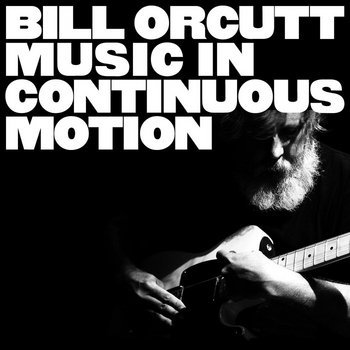
Bill Orcutt, “Music In Continuous Motion” (Palilalia, 2026)
Back in 2022, Bill Orcutt released his excellent Music for Four Guitars album, which led to the formation of a killer touring quartet featuring fellow avant-guitar luminaries Shane Parish, Wendy Eisenberg, and Ava Mendoza. Orcutt clearly found that experience inspiring, as he later started a similarly formidable trio with Sonic Youth’s Steve Shelley and Comets on Fire’s Ethan Miller. In keeping with that theme, Music in Continuous Motion is yet another album composed for a quartet of guitars, but this one “pointedly steps away from the cut-and-paste constructivism” and “discrete, mechanistic precision” of its predecessor to embrace a more melodic, human, and performance-driven aesthetic. While Orcutt himself impishly summarizes this latest direction as “a bridge pickup record more than a neck pickup record,” my own take is that it feels like a spiritual descendant of the best bits of Glenn Branca, Gang of Four, Built to Spill, and Archers of Loaf with a distinctly Orcutt spin. Unsurprisingly, it also feels like yet another great album from one of the most reliably compelling and singular guitarists around.
To my ears, the opening “Giving unknown origin” is the piece that best captures Orcutt at the height of his powers, as it features a bright and memorable melody, an incredibly cool and intricate central motif, and plenty of snarl, bite, and obsessive repetition. He also makes incredibly effective and dynamic use of the stereo field, which makes it possible to discern how all of its masterfully interwoven moving parts are evolving and interacting. While I certainly dig the various riffs and melodies and the shifting dynamics, “Giving unknown origin” is also an excellent showcase for some of the more general aspects of Orcutt’s vision that I love, such as the way he balances machine-like pattern repetition with more viscerally slashing elements. The best bits feel like a duel in both a literal sense (staccato rhythmic interplay) and a more profound and abstract sense (beauty vs. violence, order vs. chaos, etc.). Also, I would be remiss if I did not also note that I was surprised to discover that Orcutt can unleash taut, angular, and urgent-sounding riffage as well as any ripping post-hardcore band, which is not something I would have guessed from his previous work.
Amusingly, Orcutt noted in a recent Tone Glow interview that the main reason that he wanted to record this album was that he wanted to keep doing live quartet shows yet concluded that it would be “lame” to do that without actually having some new songs to play. Avoiding shame can certainly be a great motivator. Upon hearing the album, however, I was struck by how that half-joking/modest admission contrasted with the level of inspiration behind these twelve pieces, as it seems like Orcutt was absolutely drowning in new and varied ideas for this project.
In fact, the only truly consistent themes that run throughout the entire album are a ruthless economy and the actual mechanics of Orcutt’s compositional arc. As Tom Carter puts it, each piece weaves “four gleaming threads into…an evolving, complex texture that employs simple, repeating motifs to build new melodies from counterpoint itself.” He further notes that this is consistently achieved in “the most efficient manner possible” and that each piece essentially “slams shut like a clockwork music box” after about two minutes. That short and punchy approach works quite beautifully, as each piece hits hard and then vanishes without ever overstaying its welcome. The trick, of course, is making that approach feel complete rather than truncated and Orcutt hits that mark quite effectively time and time again. It genuinely feels like he has devised a near-perfect system for building these multi-guitar miniature puzzles, as whatever he feeds into it seems like it invariably blossoms into something compelling and vibrantly alive within a mere two minutes.
While damn near every piece features at least one cool and memorable motif at its heart, there are several pieces that stand out as especially dazzling. In particular, I love the comparatively simple and spacious “Now nearly gone,” as Orcutt unleashes an absolutely gorgeous and soulful solo over a languorous backdrop of chiming arpeggios. “Barely there” is similarly lovely, but takes a more swaying, sensuous, and summery tone. Elsewhere, “Unexpectedly heavy” appropriately unveils an unexpectedly heavier pleasure, as droning and pulsing Glenn Branca/early-Sonic Youth-style “wall of sound” chords relentlessly propel a haunting spy movie melody. I also love the way that the bright and melodic opening riff in “And warm to the touch” gets broadsided and quickly entangled by an arpeggio pattern that confuses its rhythm. It is fascinating and illuminating to hear how a sophisticated vision like that can spring forth from the same mind that elsewhere unleashes playfully blurting, wonky, and broken funk (“Yet always moving”) or a goddamn Bo Diddley beat (“Unfinished not fragile”).
Naturally, some of those directions appeal to me more than others, but even the album’s lesser pieces are ingeniously constructed enough to grab and hold my attention (though it certainly helps to know that yet another banger is always a mere two minutes away). While my initial gut feeling was that Music For Four Guitars remains the stronger of Orcutt’s two proper guitar quartet albums, it ultimately occurred to me that I was basically comparing constructivist apples to rockin’ oranges, as the two albums are similarly great in very different ways. For example, Music in Continuous Motion is certainly more surprising and vibrant than its predecessor. It definitely hits some higher highs as well.
On a deeper level, however, it also feels like an improbable culmination of the many eclectic and divergent directions and influences that Orcutt’s singular career has assimilated over the years (everything from volcanic noise convulsions to The Great American Songbook). Attaining such a confident “anything goes” approach to art is certainly a life’s work, but I suspect that the experience of playing live night after night with three similarly imaginative and open-minded guitarists was probably the biggest influence of all though. That certainly bodes quite well for the future: as great as this album is, I can guarantee that an even sharper and more viscerally electric vision will take shape by the end of the next tour.
Listen here.