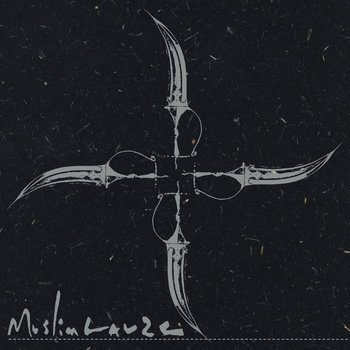
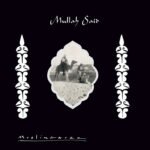
This latest release from the seemingly endless Muslimgauze archive is a bit of an enigma and a surprise, as it was apparently “assembled posthumously” from “previously unreleased material.” Admittedly, that half-true claim could reasonably be made about A LOT of archival Muslimgauze album releases that have surfaced in the years since Bryn Jones’ untimely passing in 1999, but the difference is that this album was assembled by Staalplaat rather than being one of the many “finished” albums that had previously only surfaced in a limited edition or simply got shelved and forgotten about due to the staggering pace with which Jones churned out albums in his lifetime.
In the world of Muslimgauze, however, normal distinctions between albums and eras are blurred into meaninglessness, as at least three of these pieces have previously been released in very similar form elsewhere. If normal rules applied, such obvious recycling would definitely annoy the hell out of me, but these eight pieces feel right together and capture some of the more killer grooves of Muslimgauze’s mid-’90s Indian/Bhangra-inspired work.
For what it’s worth, the most illuminating clue about the provenance of these recordings is that the title piece seems to be an alternate version of “Lahore” from 1998’s Lahore & Marseille single. A couple of the other pieces (“Tariq Aziz” and “Maskara”) eventually surfaced later on 2012’s Souk Bou Saada, but they were presumably recorded around the same time as “Lahore” as the same few samples recur throughout these eight pieces. Notably, someone on Discogs scathingly observed that Souk Bou Saada seems to have been crafted almost entirely from a sample pack entitled World Zone Vol. 1: The Far East that was released in 1996, so that is probably true here as well. In Jones’ defense, however, he certainly wasn’t the only electronic music artist excited about sample packs and home recording software in the ‘90s and neither Souk Bou Saada or Muslimlahore were actually released by Jones himself.
Obviously, it is very easy to retroactively ridicule Jones for his reliance on commercial sample packs, his blatant cultural appropriation, and his seemingly endless recycling of the same material. There is inarguably a lot about Muslimgauze that is wince-inducing. However, there is also a lot about Muslimgauze that is really fucking cool too and I personally choose to view Jones as something of a wildly overachieving outsider artist. For example, Jones lived with his parents, rarely ventured outside his studio, and never visited any of the places that obsessed him, yet he still managed to invent a radical new strain of heavy dub that people are still listening to almost three decades after his death.
He also conjured an entire mysterious and exotic world without leaving his room much, which is legitimately an impressive achievement. Obviously, that achievement is blunted and complicated by the fact that a very real Middle East exists, but Jones’ own haunted and imagined version of it is still compelling in roughly the same way that Mark Hogancamp’s WWII fantasia Marwencol is compelling.
Given that, Jones’ career certainly makes a strong case for the transformative power of making full use of your local library. Authenticity is certainly cool and all, but anything can be the perfect source material if it is wielded in suitably inspired fashion and Jones definitely had his moments. Also, the flipside of Jones’ obsession with all things Arabic is that he was definitely way ahead of the curve on anti-colonialism and being enraged by the unending nightmare of Palestinians, which must’ve been quite a lonely stance back then (particularly since people are still constantly conflating anti-Zionism and anti-Semitism in 2026).
Notably, one of the more striking features of Muslimlahore besides the Indian-inspired percussion loops is that the music is very minimal and edit-free, which makes me wonder if these songs were merely intended as spontaneous experiments in which Jones manipulated percussion loops in real-time to jam along with samples of flute solos, dulcimer, or bowed string improvisations. On the lesser pieces, that approach can certainly feel a bit disjointed and half-baked, but the instrumentation does evoke and sustain an immersive atmosphere of sorts. While the instrumentation has probably never felt more phoned in on a Muslimgauze album than it does here, that also means that there are no brooding or oppressive atmospheres casting shadows over Jones’ vibrant and visceral percussion loops.
In fact, Jones’ unusually minimal approach to the music here can be extremely effective when he unleashes an especially hypnotic and propulsive groove. If Jones actually intended to release these pieces, the gulf between the complexity of the music and the complexity of the beats is extremely amusing, as it suggests that he obsessively worked at crafting absolutely killer 3- or 4-second percussion snippets, then thought “I’m just gonna slap a flute solo or some shit on that beat for now and maybe I’ll get back to it later. Probably not though.” Improbably, however, that approach somehow produced a few legitimate bangers of the monomaniacally one-dimensional variety, which makes Muslimlahore a legitimately compelling album despite its obvious shortcomings (it definitely helps that Staalplaat exclusively chose pieces with great beats).
To my ears, the opening “Sikhizlam” is the album’s most obvious highlight, as a rolling groove with a juddering bass motif and an electronic blip melody relentlessly barrels forward beneath a breathy and serpentine flute solo. While the beat itself is certainly cool, the real magic of the piece lies in the instability of that beat, as it is continually distorting, splattering, blurting, squelching, and stalling in impressively dynamic fashion. The overall effect feels akin to desperately racing across a crater-filled desert in a ramshackle jeep while bombs rain from the sky around me. It is also reminiscent of a cowboy riding a bucking bronco: an intensely white-knuckle and out-of-control experience in which the fact that there is no discernible evolution does not detract at all from the fact that the cowboy is very much holding on for dear life.
Elsewhere, “Tariq Aziz” is a considerably more hypnotic gem, as an unstoppable juggernaut of a groove with an subtle edge of hiss, distortion, and menace unstoppably lurches forward for more than ten minutes. I also enjoyed the title track and “Hinduzeen” quite a bit as well, but the qualities of individual pieces are kind of irrelevant here, as every piece is essentially a variation on the theme of distorted and crunching locked groove-style Indian beats that unpredictably splatter and convulse beneath the impressionist strains of Middle Eastern melodies.
In short, this is definitely a love it or hate it album, as it distills Muslimgauze to its most minimal percussion-driven essence and does not offer much beyond that, yet it also captures Jones at the height of his eclectic and spontaneous beat-mangling powers. Given the half-finished/first draft feel of some of these pieces, Muslimlahore is a raw and no-frills beat blowout strictly for the fans, but it certainly works as a well-curated selection of some of some of the Muslimgauze’s most banging beats and that is not an experience that is readily available elsewhere.