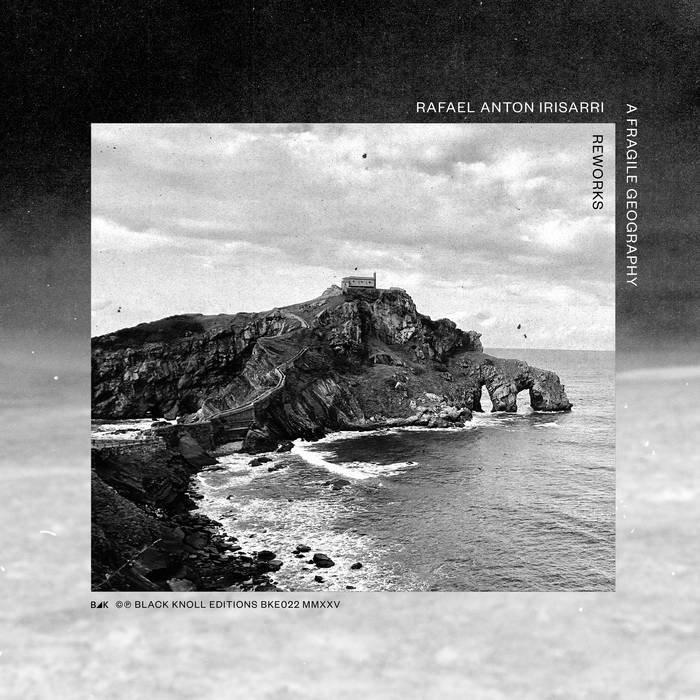
Rafael Anton Irisarri, “A Fragile Geography: Reworks” (Black Knoll Editions, 2025)
To celebrate the remastered tenth anniversary reissue of his 2015 opus A Fragile Geography, Rafael Anton Irisarri invited an eclectic murderers’ row of his friends and peers to work their transformative magic on his source material. That was a bit of a bold and inspired decision given that the original album is quite bleak and grayscale in nature, but Irisarri’s well-chosen group of reinterpreters found a number of fresh and inventive ways to highlight their most inspired bits or sharpen them into something that beautifully transcends their original inspiration. To my ears, Abul Mogard and Kevin Martin largely steal the show with their killer contributions, but this whole album is a quite a fascinating companion piece to one of Irisarri’s most celebrated albums (and even manages to surpass it on several occasions).
Notably, this reworked version of A Fragile Geography mirrors the sequence of the original pieces, which means that each artist was tasked with reworking a different piece and that the overall arc of the album remains largely intact (albeit significantly transformed as well). There is also a bit of a loose trajectory towards departing more and more dramatically from the source material as the album unfolds, as the first two pieces are largely nuanced and subtle enhancements rather than complete overhauls.
In KMRU’s “Displacement” for example, the frayed drones, tape hiss, and bleary synths are instantly recognizable as Irisarri’s own, but the pulse is a bit more sensual and the added layers bring out a bit more emotional depth and hidden beauty. Penelope Trappes’ “Reprisal,” on the other hand, feels like a howling dust storm is slowly enveloping a desolate stretch of desert highway littered with crackling downed power lines. That too hews quite close to Irisarri’s own vision, but Trappes also adds some haunting Doppler effect-style vocal swells that evoke a ghost train barreling through the gritty, landscape-obliterating maelstrom.
Things start to diverge from expected Irisarri territory in earnest with Kevin Martin’s take on “Empire Systems,” however, as a motif that sounds like a fretless double-bass gives the minimal grayscale ambiance of the source material a hypnotic and sensuously serpentine pulse. Gradually, a kick drum, high hat, and a snare roll work their way into the picture as well, but they fade in and out like a mirage. The piece is further enhanced by sliding koto-like melodic flourishes, snare rolls that dissolve into static, and a smoldering, howling, and noise-ravaged crescendo.
Elsewhere, Guatemalan avant-cellist Mabe Fratti provides the album’s boldest reimagining, as “Hiatus” becomes a lovely vocal and cello piece entitled “Ausencia” that is beautifully anchored by Irisarri’s warbly and wounded-sounding synth motif. Abul Mogard, on the other hand, sticks surprisingly close to the structure of Irisarri’s original, but transforms it into something considerably more harmonically lush and dream-pop adjacent. In fact, it may very well be one of the most gorgeous and poignant slow burners in the Mogard oeuvre (and makes fine use of Irisarri’s warbly, static-veiled synth melody as well).
The album closes with a drolly amusing and surprisingly effective wildcard, as William Basinski and engineer Gary Thomas Wright significantly punch up “Secretly Wishing For Rain” by simply adding the sounds of a dramatic thunderstorm to Irisarri’s elegiac reverie. Notably, the original erred a bit too much towards “oppressively sad” for my taste, but Basinski’s decision to shift the focus to the elemental power of a torrential rain storm ingeniously enhances the bleak beauty of the original and the chorus of birds at the end closes the album on much more hopeful note than its predecessor.
In fact, a strong case could be made that this inventively varied and eclectic reworking of A Fragile Geography categorically surpasses the original, but the focused vision and improved sound of the remastered anniversary edition make it quite a tight contest. Significantly, many of my favorite moments from Reworks tended to be Irisarri’s own motifs from the original, so the success of this album is more about the varying ways that the artists found to highlight his strongest themes than about imposing their own visions. That is an extremely cool approach to collaboration and Irisarri was lucky to find six such sympathetic reinterpreters of his art. As such, Reworks is legitimately essential listening for anyone who loves A Fragile Geography (as well as anyone who wants to hear Abul Mogard at his finest).
Listen here.