
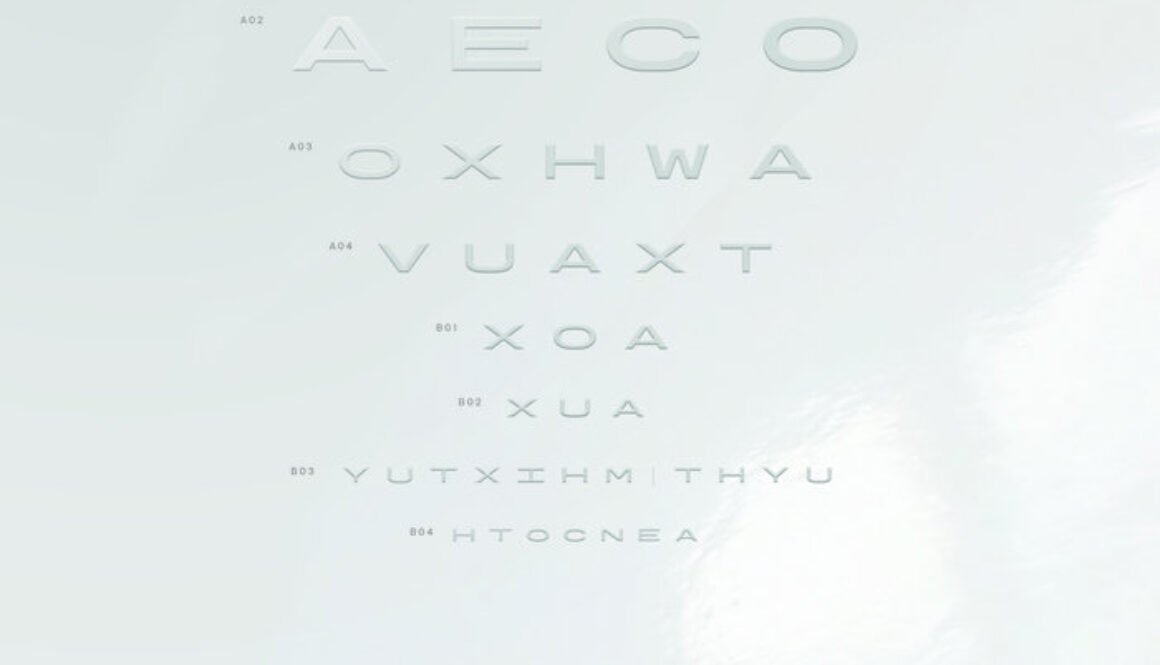
Daniel Lea & Jamie Michael McCarthy, “H T O C N E A” (Vast Habitat, 2025)
I first encountered Los Angeles-based composer Daniel Lea through L A N D’s excellent Anoxia album back in 2015, but he has become considerably more prolific in recent years after launching his own Vast Habitat imprint. This first collaboration with London-based violinist/cellist Jamie Michael McCarthy has apparently been a decade in the making and borrows both its title and some of its ingenious inspiration from an eye test chart that McCarthy found on the street. On its face, the resultant album has the shapeshifting moods and immersive spell of an art-damaged science fiction score, but immersive headphone listening reveals a considerably deeper and more compelling vision lurking within. Part of that is due to Lea’s considerable sound design talents and inventive assimilation of influences ranging from austere dub techno to avant-garde piano composers and contemporary electronic heavy hitters like Ben Frost and Tim Hecker, but the unusual structural dynamics of these pieces are quite unique and mirror the shifting depth of field that one might get from experimenting with different lenses.
The opening “H L A O T“ provides an especially illustrative introduction to the duo’s slowly blossoming vision, as it deceptively opens with deep dark ambient exhalations before some smearing and curdled higher frequencies unexpectedly give way to a series of lingering, murkily dissonant piano arpeggios. From there, the piece gradually develops into a sort of slow-motion and noirish strain of piano jazz ravaged by snarling and roiling eruptions of Hecker-esque distortion. That unsurprisingly proves to be quite an effective combination, but the piece’s best moments do not happen until after the structure completely collapses and distends to leave behind only heaving seismic rumbles, scrabbling string noise, crackling distortion, and deep and rolling bass throbs.
That rough template largely remains consistent throughout the entire album, as every single piece goes through a series of radical transformations and features at least one impressively cool and inventive motif at its heart. In keeping with the “shifting depth of field” theme, however, the pair’s strongest ideas are equally likely to gradually come into focus from the lower depths as they are to take shape in the melodic foreground. A prime example of this unpredictable structural sorcery is “V U A X T,” as the piece gradually transforms from deconstructed synth pop to an interlude of churning and dramatic strings before blossoming into a killer motif of complexly interwoven piano loops. While that would have been a wonderful destination for the piece to remain, Lea and McCarthy instead boldly derail that beautiful passage with a sudden intrusion of reverberant, murky arpeggios and hissing field recordings of rain. It is the sort of move that absolutely should not work, but the dark clouds of tumbling piano and stammering sub-bass of the coda turn out to be a similarly impressive highlight.
The following “X O A“ is arguably the album’s strongest piece, as it gradually evolves from smeared string drones over a wonderfully Pole-esque backdrop of clicks, pops. and amp noise into a gorgeously billowing and immersive ambient dreamscape. While crafting lovely ambient pieces is definitely familiar territory for McCarthy’s solo work as Cerfilic, the success of “X O A“ is primarily due to its more conventionally satisfying arc than the strength of its individual motifs (the two artists were certainly not starving for strong ideas throughout the album). Unusually, however, the pleasures of the individual pieces are secondary to both the vividly realized and texturally rich album-length experience and the more ephemeral and intense pleasures of some specific motifs. For example, the album’s first single “X U A” features an absolutely brilliant collision between out-of-phase piano loops, deep bass, and sexily sibilant digitized voices.
Elsewhere, the groaning and moody string theme of “Y U T X I H M / T H Y U” is violently displaced by the explosive introduction of an Oval-esque motif of skipping and stammering electronics. Moments like those are absolutely screaming for the remix treatment, as a savvy dance music producer could definitely whip up some serious god-tier grooves from Lea and McCarthy’s tossed-off flashes of inspiration. Perhaps there is potential for such an endeavor in the future, as Lea has previously collaborated with Guy Brewer (Shifted/Carrier) as New Corroded, but H T O C N E A is quite an unusual, innovative, and absorbing work in its current incarnation as well. The endlessly shifting sands of the duo’s song structures can admittedly feel challenging or exasperating at first, but H T O C N E A is the sort of album that only becomes more compelling with deeper listening, as Lea and McCarthy have crafted a feast of razor sharp sound design and unwaveringly innovative compositional arcs.
Listen here.