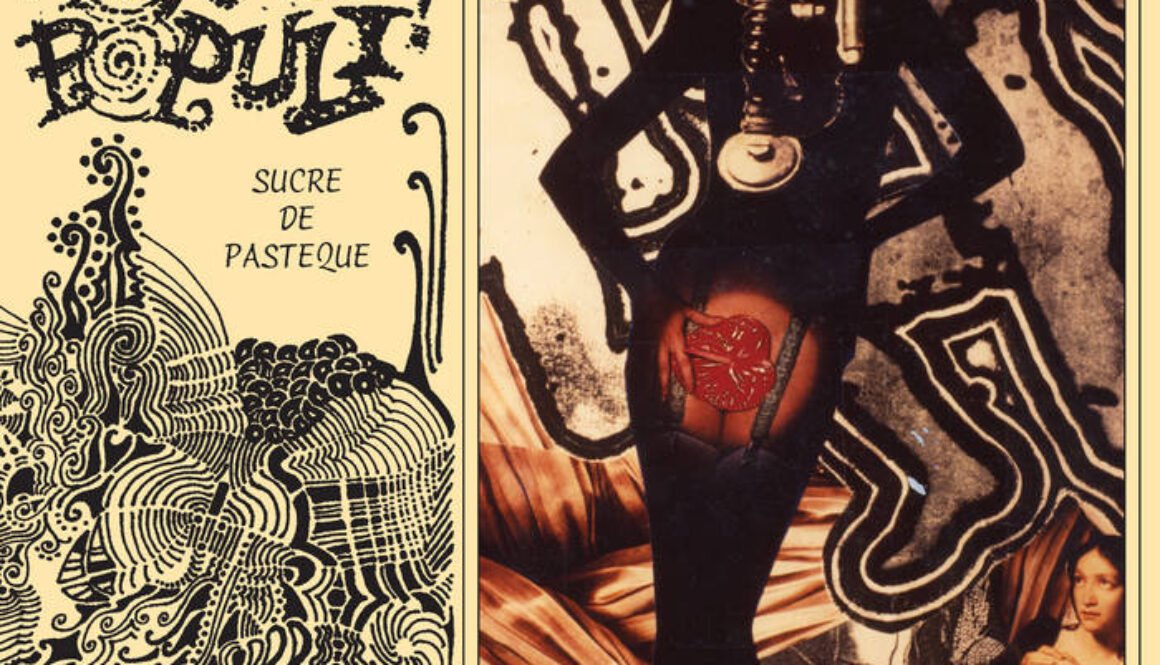
Vox Populi!, “Sucre De Pastèque” (Unlikely Records (1986)/Dark Entries (2025))
This erratic yet endlessly fascinating group of Parisian iconoclasts has been enjoying a bit of a well-deserved renaissance in recent years, as Spencer Clark’s 2013 reissue of their finest album (1987’s Half Dead Ganja Music) garnered enough interest to warrant several more reissues over the last decade or so. This latest album to be rescued from obscurity celebrates its 40-year-anniversary with a fresh remastering and some cool new cover art.
Previously only issued on the English Unlikely Records label run by Rimarimba’s Robert Cox, Sucre De Pastèque (Watermelon Sugar) captures the band just before they hit their Half Dead Ganja Music zenith. While no one is likely to hail these sketch-like and improvised-sounding vignettes as another freshly unearthed masterpiece, Sucre De Pastèque is nevertheless quite an endearing album, as there were not a lot of families churning out industrial-damaged and Persian-inspired psychedelic DIY weirdness in their living room in the 1980s. More importantly, Vox Populi! found quite a lot of interesting ways to inventively misuse their primitive electronics.
Making sense of Vox Populi’s discography has always been a bit of challenge, as their albums have turned up in various unofficial and digital forms over the years with varying track lists and the group has always had a perplexing fondness for giving band members enigmatic pseudonyms as well. The core of the band, however, has always been self-taught multi-instrumentalist Axel Kyrou (credited here as Gnouf Tap), who first founded the project in 1981.
The line-up expanded significantly in 1984, however, as Axel was joined by his future wife Mithra (or Mitra) Khalatbari-Kyrou and her more conventionally talented brother Arash Khalatbari (his later band Ekova was signed to Sony Classical). Notably, Axel is partly of Palestinian descent and Mithra and Arash are both Iranian émigrés, so Vox Populi’s vision is very much the sound of two very different worlds colliding, as the band always had one foot in the experimental/industrial scene and another in the traditional Middle Eastern music community.
Since these recordings span 1984 to 1986, some of these pieces likely date from the group’s earliest attempts to expand and define their sound. The trio were also regularly joined by a revolving and eclectic cast of friends and collaborators and the most consistent of those was bassist Frances Manne (Fr6 Man, FRG Man) who turns up for this album’s second half and also contributed the new cover art collage.
On this particular album, Mithra is credited with vocals, acoustic guitar, and flute and Axel is credited with damn near everything else (though Arash contributes some hammered Persian dulcimer on a few tracks). At the risk of sounding reductive, that basically translates as a bunch of Middle Eastern-sounding flutes, horns, and percussion instruments filtered through tape loops and effects to fragmented, hallucinatory, and dub-wise effect, but there are also some occasional synth-derived beats and grooves to be found as well (and, this being the ‘80s and all, some occasional stabs at slap bass and stilted funkiness).
In general, Vox Populi’s best songs tend to be the ones in which Mithra sings, but Sucre De Pastèque is pretty lean on those beyond the hazy and pulsing ritualistic drone of the opening “Yarom Lalou.” Instead, the bulk of the album seems devoted to simply trying out lots of new ideas in sketch-like form with varying results. I am probably most fond of the eerie flute-based pieces like the haunted dreamscape of “Be Mafu” or the lurching and serpentine “Ovan III,” but there are plenty of other charming detours to be found throughout the remaining pieces as well.
For example, the lumbering and mechanized electro-pop of “Glassy Stare” sounds like a lost minimal wave demo from Ian Curtis enhanced with the playful use of a primitive sampler, while “Atal Matal Toutoule” is an endearingly clunky, primitive, and deconstructed stab at hazed-out ethno-funk a la My Life In The Bush With Ghosts or Fat City (I especially liked how the snare wanders out of phase and the final moments resemble a surprisingly good Two-Tone groove once all the wonkier bits fall away).
Elsewhere, “Alternative Fresh” has some flashes of left-field brilliance as well, as it fitfully approximates the mutant funk chaos of a prime No Wave band. Those aren’t the only genuine flashes of inspiration, of course, but Sucre De Pastèque is more of an eccentric and transitional time capsule from the golden age of “anything goes” DIY cassette culture than a lost batch of killer singles newly unearthed.
As such, this is definitely one for those who are already fans of the band rather than the merely curious, as Vox Populi definitely have better and more consistent releases than this one. That said, any serious connoisseurs of ‘80s underground music and home recording weirdos in general will probably appreciate Vox Populi’s singular collision of tape loops, Persian poetry, traditional music, primitive electronics, and ethno-industrial grooves quite a bit, as these Parisians definitely had a vision unlike anyone else before or since.
Listen here.