
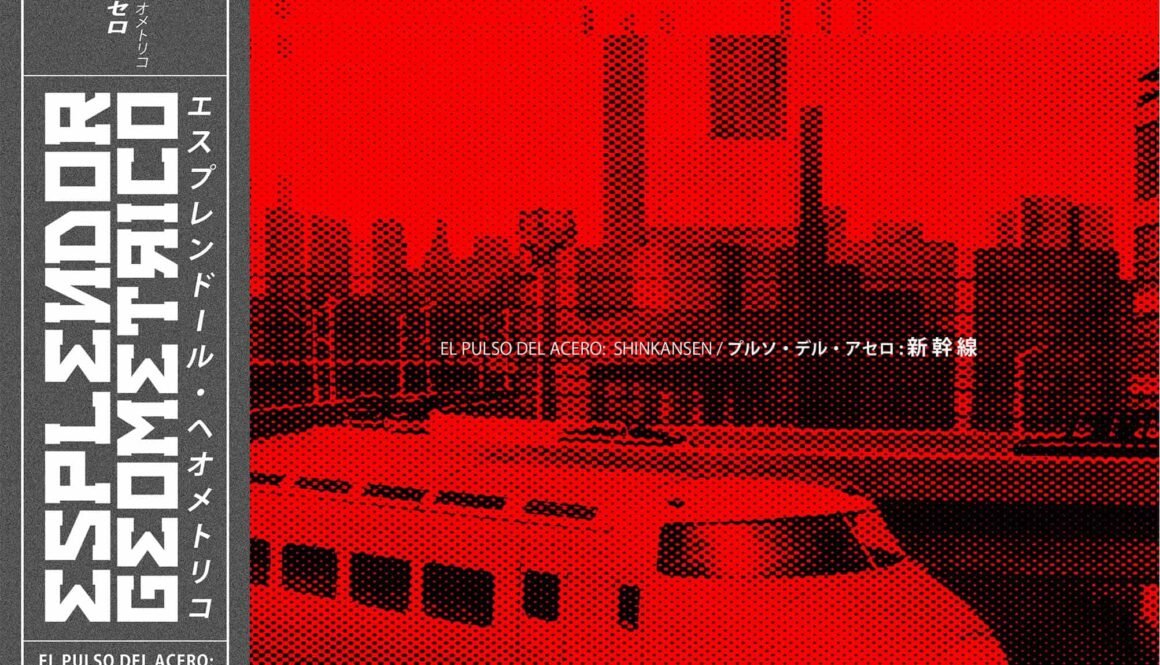
Esplendor Geométrico, “El Pulso Del Acero: Shinkansen” (Geometrik, 2025)
This latest album from the long-running duo of Arturo Lanz and Saverio Evangelista is pretty lean on background information, which is both very much in character and makes perfect sense: while there have admittedly been a few outliers over the years, Esplendor Geométrico has been unswervingly dedicated to crushing industrial percussion and noise-ravaged beats for decades. Much like a bulldozer or tank, a no-frills percussion assault like this one does not need an artist statement to justify its existence or illuminate its nuanced philosophical inspirations.
Consequently, the only real question worth asking about each new EG release is “is it good?” In this case, the answer is decisively “yes,” but that was not necessarily a foregone conclusion here, as El Pulso Del Acero: Shinkansen is a mixture of new material, reworked ‘80s material, and tracks from the band’s 2023 split with De Fabriek. In theory, such a grab bag of varied material does not sound like a recipe for a particularly focused and powerful statement, but it sure as hell feels like one this time.
As is always the case with Esplendor Geométrico in recent years, the primary draw here is the selection of crunching, mechanized, and relentlessly repeating percussion loops that sound like a factory full of clanking machines suddenly became sentient and locked themselves into a single insistently hypnotic rhythm. While the sheer power and single-mindedness of Esplendor Geométrico’s masterfully sculpted rhythms is certainly unique and visceral, the beats themselves are equally compelling and unique, as EG often feel like a contrarian branch of techno’s evolutionary family tree that has rejected all of the usual canonical influences to instead repurpose traditional rhythms into stumbling and lurching mechanized juggernauts.
As founding member Arturo Lanz hails from Madrid, a lot of EG’s rhythms often seem to be fittingly rooted in Spanish or Latin rhythms like the samba, bossa nova, or cumbia, but there are also plenty of nods to Middle Eastern, Asian, or African rhythms as well. That said, there are also some rhythms that abandon global traditions entirely in exchange for pure brute force. In fact, the album opens with one such track, as “Isla” is essentially a lurching series of depth charge kick drum explosions strafed by streaking howls and buzzing warning alarms. The overall effect is like watching a hobbled and burning snow walker from Empire Strikes Back taking its final steps before collapsing in a heap of smoldering and scorched metal.
Usually, however, the rhythms are a bit more propulsive and fun in a “post-apocalyptic sound clash” sort of way. The best example of that side is the squelching & buzzing robot funk of “Por Un Perro,” though that piece admittedly overstays its welcome a bit by cycling through the same bag of tricks for five minutes. Such indulgence is generally an exception though, as most of these pieces remind me of a mechanical bull: a wild ride begins immediately, unfolds for an unpredictable amount of time, then ends abruptly.
Sometimes the samples within the accompanying maelstrom seem timed to hit at key moments, but it is more common for the cacophonous squall to feel more like a passing electrical storm that causes all of my appliances to go haywire and all nearby radios to become suddenly possessed with voices, chanting, and shouts from temporally and geographically distant places. If there is a deeper, overarching meaning to EG’s sample choices, it is probably lost on me as I cannot understand most of the languages that drift in and out, but they certainly succeed beautifully at evoking the feeling of being immersed in volatile, roiling chaos. Similarly, any attempt at evolution within these songs is probably lost on me as well, but the duo make that chaos feel like an asset rather than a shortcoming, as pieces like “Secuela” feel like a viscerally textured full-scale riot is erupting from my speakers.
Impressively, the highlights seem to come from all three directions, but the tracks from the De Fabriek split are especially strong. In “Control,” for example, a synth throb and a spacious, skeletal beat provide the backdrop for some cool dubby manipulations of shaker rhythms, while “Central” strips away all the usual noise to leave only an insistently propulsive beat and a cool sliding hook. “Rail” is even better still, as its dragging and crunching beat sounds like a Muslimgauze banger that has been slowed and remixed to wonderfully heaving and hypnotic effect.
Elsewhere, “Héroe Del Trabajo 2025” is relentlessly rolling and throbbing resurrection of a 1982 piece, while “Auto Reverse” is a foray into crunching and throbbing power ambient in which the pulse endlessly and mesmerizingly transforms in intensity and spatial location. While I am hesitant to call that a “new trick,” there are some seemingly fresh new ideas buried throughout the album (“Renacer” sounds like an elephant with a reverb pedal jamming with a rusted and malfunctioning wave machine, for example). For the most part, however, El Pulso Del Acero: Shinkansen is great because the ideas are not new at all, as EG’s monomaniacal four-decade obsession with looping industrial percussion has sharpened their vision into a crushing, precision-engineered mechanized assault that seems to only grow more sophisticated and intensely physical with each major new statement.
Samples can be found here.