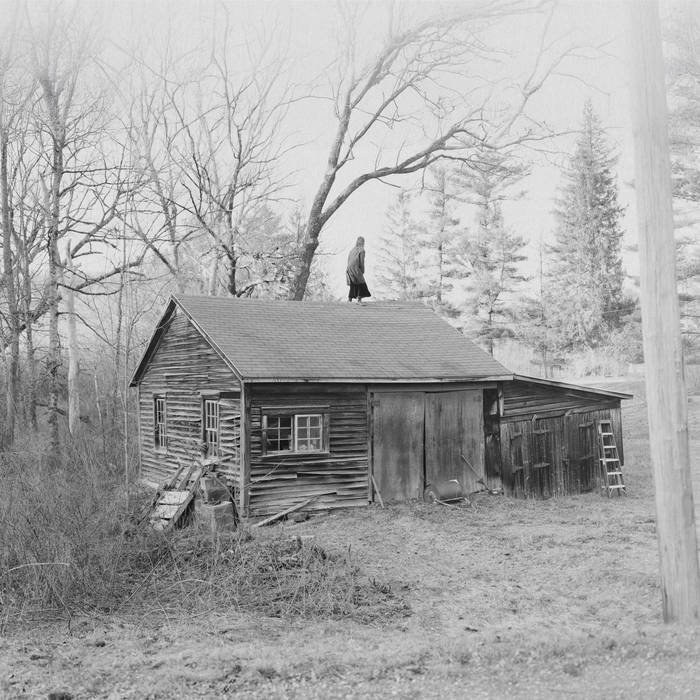
Old Saw, “The Wringing Cloth” (Lobby Art, 2025)
Now with a second pressing due to drop in March, this sprawling double LP is lamentably the final release from this beloved rustic Americana collective from New England. The decision to bring the project to an end at this particular stage is a bit of a surprising one, as The Wringing Cloth often feels like a bold creative leap forward that transcends the more drone-based fare of the ensemble’s earlier albums to expand into some fresh and more Appalachian-sounding new directions. Hopefully, that means that composer Henry Birdsey and his collaborators have another similarly great project cooking for the future, but at least there is some consolation in knowing that Old Saw’s swan song features a handful of the most beautiful pieces in their entire all-too-brief discography.
While this album is unquestionably a significant and deliberate departure from the more drone-centric structures of the collective’s previous work, the rolling and rippling waves of banjo arpeggios in pieces like the opening “Song For Paloma” often feel like a more evolved form of drone instead. I liken it to a stream or river, as the overall effect is still hypnotic, meditative, and sustained, but it comes with a sense of organic unpredictability, continual transformation, and forward motion as well.
There is also a big emphasis on pedal steel, lap steel, and resonator guitar this time around, which alternately evokes old time-y country music stretched & blurred into sleepy, slow-motion dreamscapes or a gently hallucinatory twist on a Morricone-style Spaghetti Western gunfighter showdown (“Redaction Hiss”). In fact, this whole album feels like a re-imagined soundtrack to a dreamlike Western, as it vividly evokes a series of pre-industrial scenes of lonely prairie vistas, wide open blue skies, community barn raisings, cozy wood cabins, old-time fiddlin’ and distant trains steadily chugging their way towards warm homecomings.
While that vision can certainly be quite beautiful and favorably reminds me of a less bleak Wisconsin Death Trip at times, I had a bit of a hard time fully warming to this album at first. For one, it veers a bit too heavily towards the ambient Americana of projects like Cowboy Sadness for my taste, as I am a bigger fan of Birdsey’s more gnarled and ritualistic-sounding Tongue Depressor project. There are occasionally traces of that weirder and more dissonant side like distressed tape manipulations or the visceral metal strums strums buried in the depths of “Tilt of the Lamp,” but they tend to be relegated to a subtle textural element rather being wielded as a knife that carves through the languorous, soft-focus Western reveries. It can be a bit exasperating to hear submerged evidence of the sharper edges that would have elevated The Wringing Cloth into a more intensely alive album.
I was also a bit thrown by the decision to make this a double album, as there is a pervasive similarity running through several of these pieces that significantly dilutes the album’s overall impact. While I can understand why The Wringing Cloth ultimately took the shape it did (immersive sustained mood, excitement about new directions, final release for a project with plenty of material, etc.), it is easy to imagine a more lean and distilled version of this album that would have been an absolute fucking masterpiece from start to finish.
For me, the heart of that hypothetical masterpiece would be the three-song run of “Long Distance Engraving,” “Lacustrina,” and “The Flood Spires,” as well as “Ribbons of Marble,” as all four pieces strain towards towards the transcendent in a varied and inspired ways. In “Long Distance Engraving,” for example, an organ drone with tape-warped flickers of dissonance unexpectedly blossoms into a gently hissing and clattering train rhythm that propels it through a warmly beautiful swirl of rippling acoustic guitars and swooning and sliding violin drones. The end is great too, as the shaker rhythm slowly fades away to leave behind a trebly outro of collaged machine noise. “Lacustrina,” on the other hand, is the most gorgeous incarnation of the album’s rolling arpeggio waves, as it nicely enhances the formula with some achingly beautiful chord changes and a bit of welcome (if submerged) feedback snarl.
Elsewhere, “The Flood Spirals” revisits those rolling waves in considerably more smeared and queasily dissonant fashion en route to a wonderfully immersive and hallucinatory sound collage of panning and warping ripples, train bells, industrial machinery, broken glass, feedback ghosts, and tape abuse. At its best, it lands somewhere between a swaying lysergic wheat field of exploding colors and the feeling of ascending to heaven.
“Ribbons of Marble” also seems to feature a touch of the divine, as its hypnotically pulsing banjo strums and buzzing chant-like drones organically wax and wane while subtly expanding into warmer and more haunting layers of harmony. In fact, it is so fucking beautiful that it has sent literal shivers down my spine on more than one occasion. On one level, it feels like the birth of an absolutely mesmerizing strain of rustic American minimalism, but it also feels like such a perfect glimpse of heaven that it really leaves nowhere else to go. Given that, I can partially understand why Old Saw decided that The Wringing Cloth was going to be their final statement, as they’ve managed to fitfully take their dreamlike vision of wood-and-steel Americana to the highest heights that they (or anyone else) could possibly hope to reach.
Listen here.