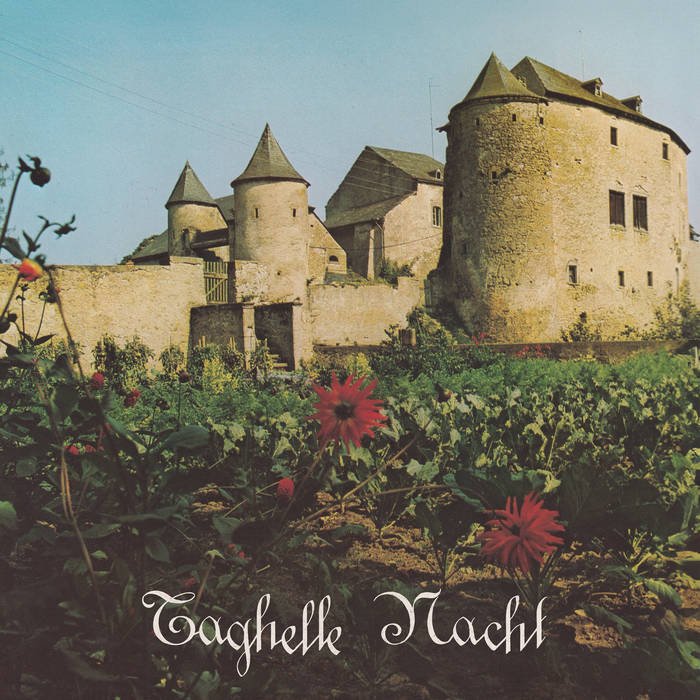
Roudi Vagou & Läuten der Seele, “Taghelle Nacht” (Quindi, 2026)
This latest album from Christian Schoppik feels like a bit of a curious outlier or comparatively modest release in the wake of last year’s stellar Unterhaltungen Mit Larven Und Überresten, but it is a characteristically fascinating one nonetheless. Schoppik’s collaborator this time around is Matthias Kremsreiter, who debuts his new Roudi Vagou alias but normally records as alibikonkret. While the two artists certainly share a fondness for dark psychedelia and haunted atmospheres, Taghelle Nacht (Daylight Night) feels like a completely new vision that suggests a Bavarian twist on Grey Gardens experienced from the perspective of a ghost and DJed by The Caretaker’s haunted Victrola: a slow-motion drift through the moldering, dust-covered ruins of a once-opulent seaside mansion in which vivid memories of the past continually bleed into the present in subtly unsettling and hallucinatory fashion.
As befits an album with such a mysterious and elusive vision, Taghelle Nacht is divided into two halves (like a split release) with Roudi Vagou credited with the first eight pieces and Läuten der Seele with the rest, but the differences between the two artists are so blurry that they are largely irrelevant. The reason for that is two-fold, as the album feels like a series of impressionistic vignettes shaped from the same small palette of samples and instruments and the more melodic bits tend to flicker and vanish like phantoms (“snatches of song drift by like dreamlike fragments, and achingly tender flourishes fleetingly appear and retreat”).
That approach appears to be both quite deliberate and thematically consistent, as the album’s description alludes to “old-world beauty buried in dust” and motifs “momentarily caught in the light before retreating into the shadows once more.” For the most part, the overall effect is teasingly enigmatic and moody rather than sinister, as a backdrop of smeary drones conjures a shadowy atmosphere in which the fabric of time and space has become supernaturally porous and dust-covered radios and televisions fitfully flicker back to life to broadcast century-old snatches of waltzes, arias, pop songs, schmaltzy orchestral music, and film dialogue mingled with the more real and immediate sounds of sloshing waves, footsteps, and chirping birds.
Given that, the pleasures of Taghelle Nacht are best experienced as an immersive album-length descent into subtly intensifying mindfuckery, as whatever hooks or highlights emerge tend to be both ephemeral and unpredictable. The album does seem to have a gradually deepening arc of sorts, however, as the Roudi Vagou pieces feel like the dawning realization that I am not necessarily alone in this ruined mansion, while the second half generally features more frequent, sustained, and varied psychotropic disturbances.
There are definitely exceptions to that arc, however, as Roudi Vagou’s “Iss Mich Ganz Auf” feels like a ghostly ballroom dance juxtaposed with sounds of a woman weeping and something that sounds like the chants of a black mass murkily emanating from the basement below, while the following “Grenzüberschreitung” is filled with the sounds of laughter and swooningly romantic Hollywood strings (albeit in increasingly frayed, smeared, and curdled form). My favorite piece is probably the blurred, out-of-sync waltz of the closer “Mondrätsel,” as it features a charming and playful final duet, but I also enjoyed the way that pieces like “Punkt Mitternacht” and “Ein Kitzeln In Den Gräbern” rhythmically heave, throb, and pulse like the very fabric of reality is bulging and straining from the efforts of some restless supernatural entity.
Unsurprisingly, the pervasive sense of amorphous and drifting unease coupled with the lack of any discrete highlights make Taghelle Nacht one of the more challenging and hard-to-grasp releases in Schoppik’s recent oeuvre, but that is entirely by design rather than evidence of any creative or compositional shortcomings on either artist’s part. While it is unlikely to ever be the first Läuten der Seele album that I reach for or recommend to someone, Taghelle Nacht does scratch a very specific itch (a hallucinatory journey through the ruined palaces and lingering psychic residue of the early 20th century European aristocracy) and does so very effectively. I suspect that fans of Kassel Jaeger, Stephan Mathieu and Akira Rabelais’ 2016 Thomas Mann homage Zauberberg will especially dig this one.
Listen here.