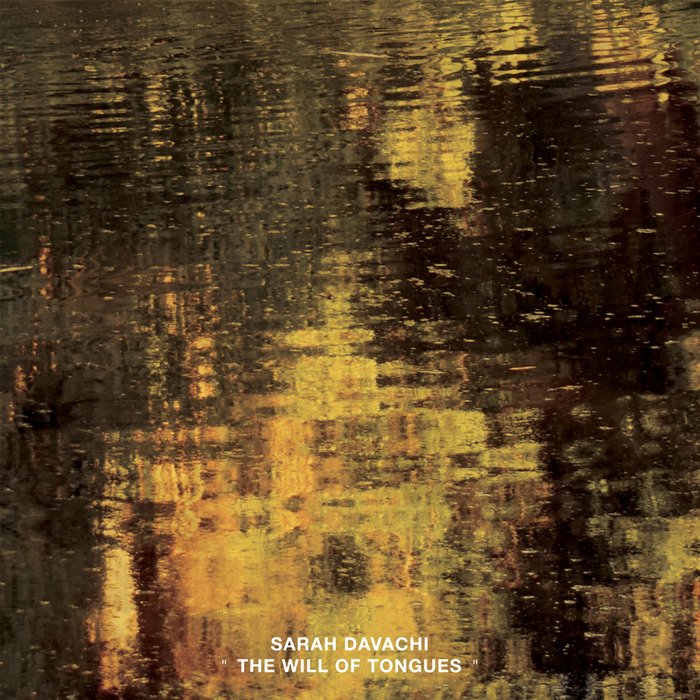
Sarah Davachi, “The Will of Tongues” (Late Music, 2026)
Billed as this Los Angeles-based composer’s “most ambitious work to date,” this overwhelming triple LP collection brings together five solo pipe organ compositions, a choral suite, a collection of “interludes” for microtonal ensembles, and a new longform chamber piece. Notably, Davachi recently completed a doctoral study in timbre, phenomenology, and critical organology and The Will of Tongues very clearly feels like the fruit of all those years of research, which is another way of saying “this is extremely challenging music.” The emphasis is primarily upon “compositional concepts and methods that have preoccupied Davachi over the past decade” and that list covers “iteration, tuning theory, textural and timbral variation, extended duration, vertical harmony, intervallic affect, and canonic structure.” In short, this is one for the deepest of deep listeners, as Davachi brought in a sprawling and eclectic cast of guests ranging from avant-garde luminaries like Eyvind Kang to a microtonal brass ensemble to a Renaissance flute consort for a durational yet time-dissolving deep dive into the minutiae of timbre and harmony.
In one of my favorite sketches from Tom Scharpling’s The Best Show (“The Music Scholar”), the endlessly hilarious Jon Wurster calls in pretending to be a jaded and relentlessly namedropping record store owner who proceeds to dismiss absolutely every good band ever. After casually trashing everyone from The Beatles to Big Star, he gradually reveals that his taste has become so sophisticated that he can now only listen to field recordings of complete silence recorded by one specific artist.
I bring that up because much of The Will of Tongues sounds like it would have been one of the final stages in that character’s musical evolution before they completely transcended all conventional music forever, as Davachi pointedly abandons entry level bullshit like hooks, rhythm, or melody to focus almost entirely on the pure pleasures of sound itself. More specifically, pieces like “Interlude I: Polyphonic, for Strings” feel like drone or chord studies in which tones are artfully stacked to create unusual harmonies, overtones, and oscillations. While that can certainly make for admittedly uneasy listening, that approach makes perfect sense, as the inclusion of something as easily graspable as a melody would shift the focus away from Davachi’s slow-motion harmonic transformations.
I am also reminded of the phrase “can’t see the forest for the trees,” which Davachi boldly inverts by metaphorically dismissing both the forest and the trees to zero in on the patterns in a single piece of bark. Details can contain multitudes for those with sufficient focus and patience, of course, so fans of Catherine Christer Hennix or Important Records and XKatedral’s drone- and tuning-centric compilations will find much to love here.
Notably, however, The Will of Tongues is essentially three albums in one and two of those albums are considerably less prickly than the interludes and solo pipe organ pieces. One of them is closely related, however, as the two-part “The Rose Dialogues” feels like all of those isolated glacial transformations and sustained tones have been beautifully woven into a durational mosaic that feels both sacred and cosmic once it reaches its full power. Improbably, that piece first premiered in my neck of the woods (it was a commission for Troy, NY’s EMPAC), so I managed to experience it for the first time in an appropriately immersive way. While I am not sure that my attention span at home would have met the challenges of Davachi’s supernaturally slow dynamic sorcery, it certainly met them on that day and my reward was a slow-motion stunner of sensuously swaying pulses, stormy chords, complex harmonies, and shifting oscillations.
The third album lurking within The Will of Tongues (the three-part choral work “Songs of the Smile’s Fig”) is quite a different animal altogether, however, as the only overt traits that it shares with its surroundings are a timeless and sacred-sounding vision. In fact, I could have easily been convinced that it was a contemporary interpretation of a haunting century-old classical masterpiece like Faure’s “Requiem” that has been given a bleary, otherworldly sheen. For those who have a hard time following Davachi down her personal rabbit hole of slow-motion harmonic architecture, that comparatively brief suite will absolutely feel like the album’s crowning achievement, yet the subtle pleasures of the rest of The Will of Tongues run even deeper for those who can successfully recalibrate their minds to her singular wavelength.
Fittingly, returning Davachi collaborator Dicky Bahto provides some welcome help in that regard, as his three videos perfectly complement her vision (particularly this one). Hopefully, the rest of the album will someday be blessed with similarly mesmerizing visual accompaniments, as that multisensory immersion feels like the missing puzzle piece that elevates Davachi’s vision into something truly transcendent. Until then, this album feels like the very raison d’etre for Davachi’s Late Music imprint, as it would be hard to find another label eager to finance a triple LP of music this subtle, challenging, uncompromising, and willfully anachronistic. Davachi’s instincts were definitely sound though and this is one hell of a massive statement: The Will of Tongues feels like a culminating celebration of everything that she has been building toward since her label first debuted six years ago.
Listen here.