
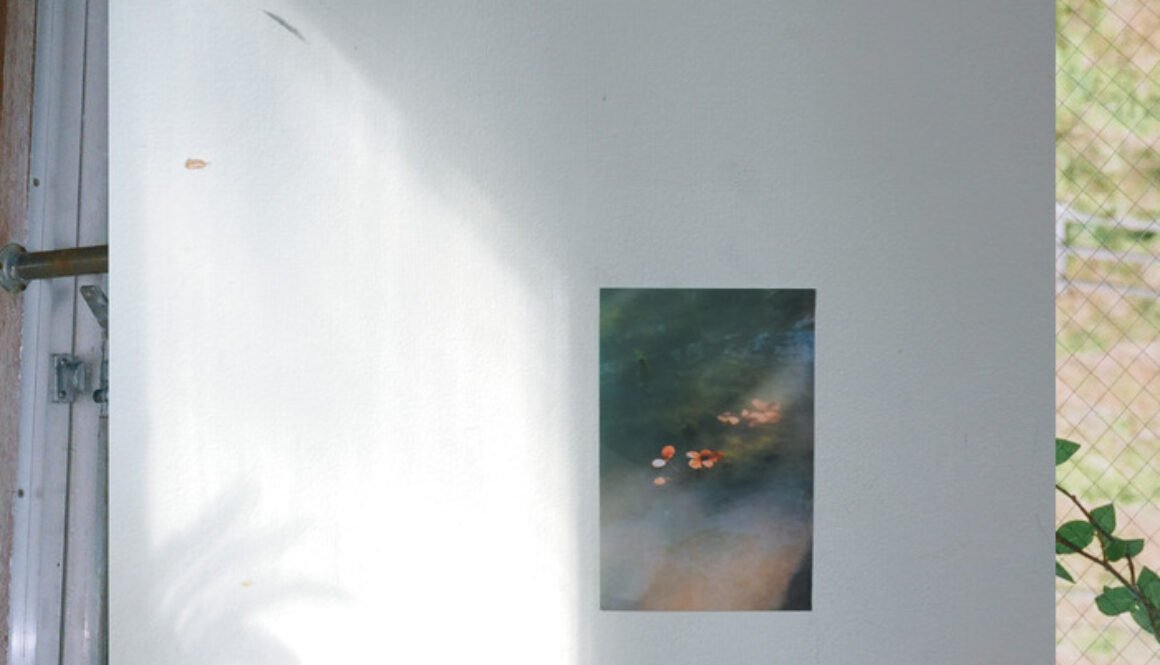
Etelin, “The Chair and the Faucet” (Pentiments, 2026)
This latest full-length from Alex Cobb (the man behind the Students of Decay and Soda Gong labels) is a fascinating departure from his usual fare, as it was inspired by a recent stay at a Zen Buddhist meditation retreat. The unusual title alludes to a short poem that Cobb wrote as “an attempt to transcribe the experience of intensive zazen through a simple image of a chair tied to a faucet by a length of rope.” In musical terms, the experience led him to work exclusively with a Serge Modular synth and “an almost entirely dry signal path, interrupted only by small, intentionally deployed instances of reverb.” In essence, the Serge “invites direct engagement with the slippery materiality of electricity itself,” which seems to have been an ideal match for Cobb’s newly heightened powers of patience, restraint, and control. To my ears, this is quite possibly his finest album to date, as its two longform pieces are gently psychotropic deep drone nirvana.
The album is divided into two sidelong pieces that are each composed of two parts. In the brief opener “The Chair I,” a harmonium-like drone languorously oscillates and subtly expands beneath subtly spacey streaks of slow-motion melody. While it is the most conventionally “ambient” piece on the album, it does feature a few more nuanced elements that foreshadow the pleasures to come, as oscillations quietly speed up and slow down and a bleary cloud of quivering overtones gradually forms and hovers above everything. In the lengthier “The Chair II,” a deeper, hollower drone conjures both a similarly bleary oscillating haze and a gently pulsing and subtly shifting rhythm.
That is merely the foundation this time around, however, as a haunted shimmer of feedback soon forms and additional layers of overtones subtly darken the harmonies en route to a buzzing and flanging crescendo reminiscent of Tuvan throat singing. While that sublime crescendo proves to be rather ephemeral, it leaves behind an extremely cool coda of pure drone and a barely audible wake of buried noise and static before unexpectedly reawakening with a cold and flanging heavy drone finale. Notably, that finale is quite ephemeral as well, which is a notable recurring theme on this album: a strong motif is briefly revealed, then vanishes forever. Cobb is clearly not one to belabor a point.
The album’s second half opens with longform “Faucet I,” which opens with a stretch that sounds like Cobb is trying to mimic the buzz of cicadas on a hot summer day, but that experience soon becomes more rich and immersive as a shimmering chord fades in and begins to sensually undulate with an accompaniment of buried crackles and reverberations. That chord proves to be a characteristically ephemeral form as well, as it lazily waxes, wanes, and fades in and out of focus like a series of mirages in a heat haze. Yet again, nothing lasts forever, as an eerie passage of moaning feedback phantoms soon takes over the piece only to be itself replaced by a buzzing, Krautrock-esque bass throb before everything slowly fades away in a hissing denouement of buried train-like sounds.
While comparatively brief (as well as unexpectedly futuristic), the closing “Faucet II” holds a few more compelling surprises, as deep and slowly undulating bass hum is gradually enveloped by a crackling squall of electronic chaos, more eerily flickering feedback ghosts, and something that sounds like the squalls of a circling seagull. Hot damn-did I just wash up reborn on a deserted beach after transcending the noise and chaos of the modern world? Sadly, no. However, I did escape for a while at least, as Cobb has fitfully crafted a sublime work of deep drone transcendence, which is no simple feat.
Absolutely anyone can make minimal drone music, but making memorable and compelling minimal drone music can sometimes seem like an almost supernatural achievement: very, very few drone acolytes turn out to be Éliane Radigue. With The Chair and the Faucet, Cobb joins the select few who are able to make it seem like they have somehow distilled the universe’s cosmic vibrations into a sensuously evolving melange of subtle oscillations and harmonies that seems animated by a much deeper and more profound hidden meaning. This is a strong contender for my favorite drone album of the year (though competition from Orphax’s Embraced Imperfections remains quite fierce).
Listen here.