
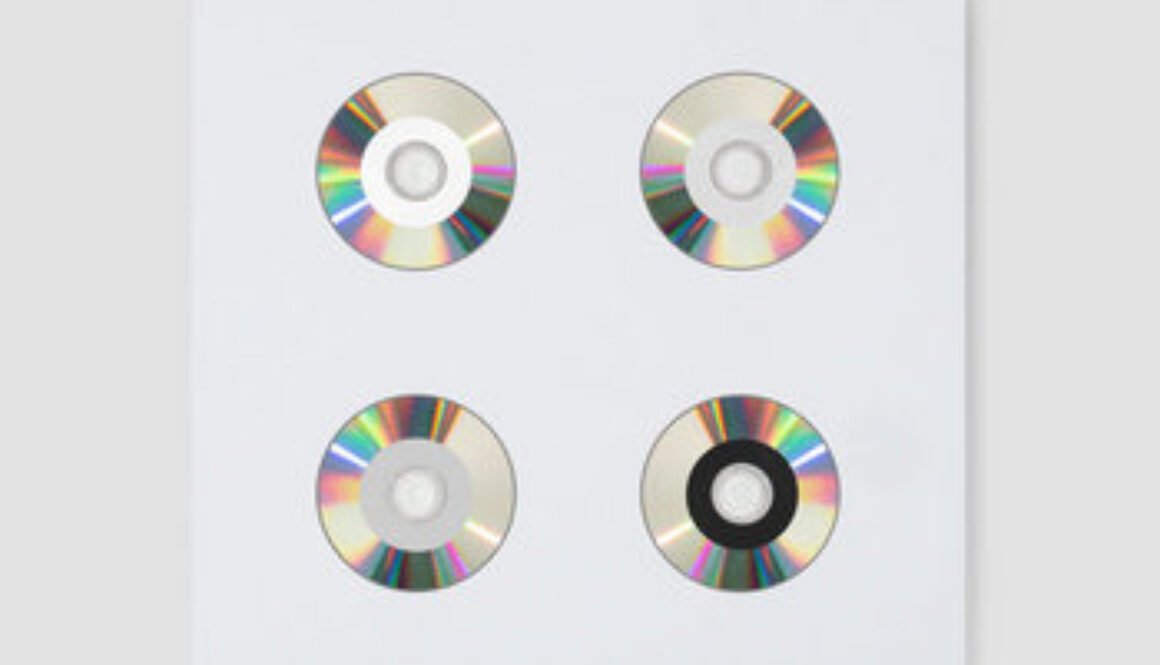
Joseph Branciforte & Jozef Dumoulin, “ITERAE” (greyfade, 2026)
This first meeting between NYC-based composer/conceptual artist Branciforte and Belgian jazz pianist Dumoulin is an impressively ambitious and mindbending “musical dialogue” recorded over the span of two days. Both artists played separate Fender Rhodes electric pianos with their “own array of processing and effects” while Branciforte further spiced up their interaction with “a custom live editing system designed to process both musicians’ outputs in real time.” The physical album is similarly unusual, as Branciforte describes it as a “multi-disc object” that divides these eight pieces into four 3” CDs that can be played in varying sequences (along with one normal-sized disc that contains the full 70-minute album in its entirety). I can certainly understand why Branciforte decided to go big with the packaging, as ITERAE is an absolutely mesmerizing and landmark release that beautifully blurs the lines between classic Oval-style glitchery, psychotropic Bitches Brew-style dark magic, and the lingering otherworldly dissonances of a great Morton Feldman piece.
As Branciforte describes it, ITERAE’s “eight modular sections hover between form and abstraction, precise sonic architecture and dream-like flow,” but a more reductionist and concise term like “ambient-adjacent” would probably suffice as well, as there are a lot of flickering and dreamlike drones at that heart of this release. That said, these pieces are considerably more harmonically complex and subtly dissonant than actual ambient music.
In the first disc’s opening “⊏,” for example, a haunted-sounded and queasily bleary chord insistently pulses beneath a dial tone-like two-note motif, but that unstable foundation is disrupted by bursts of static, blurting buzzes, and spasmodic skipping. There are some cool backwards melodies that drift through the piece at one point as well, but the real beauty lies in how the gently hallucinatory reverie feels unpredictably alive, as it never stops churning, flickering, and squirming.
Notably, it seamlessly segues into the swaying and glassy dream-drones of “⊐,” yet the fundamentally instability simply persists in different form: first as a host of quiet clicks, pops, and crackles, then as an erratic and shapeshifting undercurrent of blurting and semi-chromatic chords beneath a floating crystalline melody. It is quite a neat trick, as it creates a meditative, immersive, and gently psychotropic soft-focus fantasia that feels also vibrantly unpredictable and volatile at all times.
While I would not necessarily describe the other six pieces as variations on the same theme, the exact same song titles repeat over all four discs and the overall foundation tends to be blurred and undulating drones time and time again. There are distinctive characteristics that distinguish the various pieces, however. On the second disc, for example, the melody of “⊏” sounds more like a music box and the dissonances are more queasy and Feldman-esque, but such traits are always ephemeral, as everything is continually in a state of flux and Branciforte’s software processing ensures that every motif is threatened with dissolving, smearing, convulsing, curdling, churning, and stammering dynamic variations at all times.
As such, trying to choose a favorite piece is a fool’s errand, but the chopped and static-y Tim Hecker-esque bits on the third disc and the “Bitches Brew as a haunted ambient lagoon” psych-jazz of the fourth disc certainly stood out for me. Then again, so did the chopped and churning “ambient roar” passages of the second disc, so every single disc seems to be a winner from where I’m standing.
Branciforte and Dumoulin have truly crafted something singular and brilliant here, as ITERAE never feels improvised, unfocused, or indulgent despite the fact that the two artists had never played together before and only had two days of recording time. Instead, this album feels like a classic early Oval album that became supernaturally sentient and began sprouting a host of compelling and unexpected new tendrils. Moreover, the rearrangeable disc order feels like a legitimate feat of coherent sonic architecture rather than a mere gimmick. At 70 minutes, ITERAE is a deeply immersive, wonderfully hallucinatory, and legitimately sophisticated release in any arrangement, but the ability to seamlessly reconfigure the various sections into new forms makes it feel like an almost-bottomless sea of vibrant and flickering psychedelia. I know it is only April right now, but this is definitely an album of the year candidate for me already.
Listen here.