
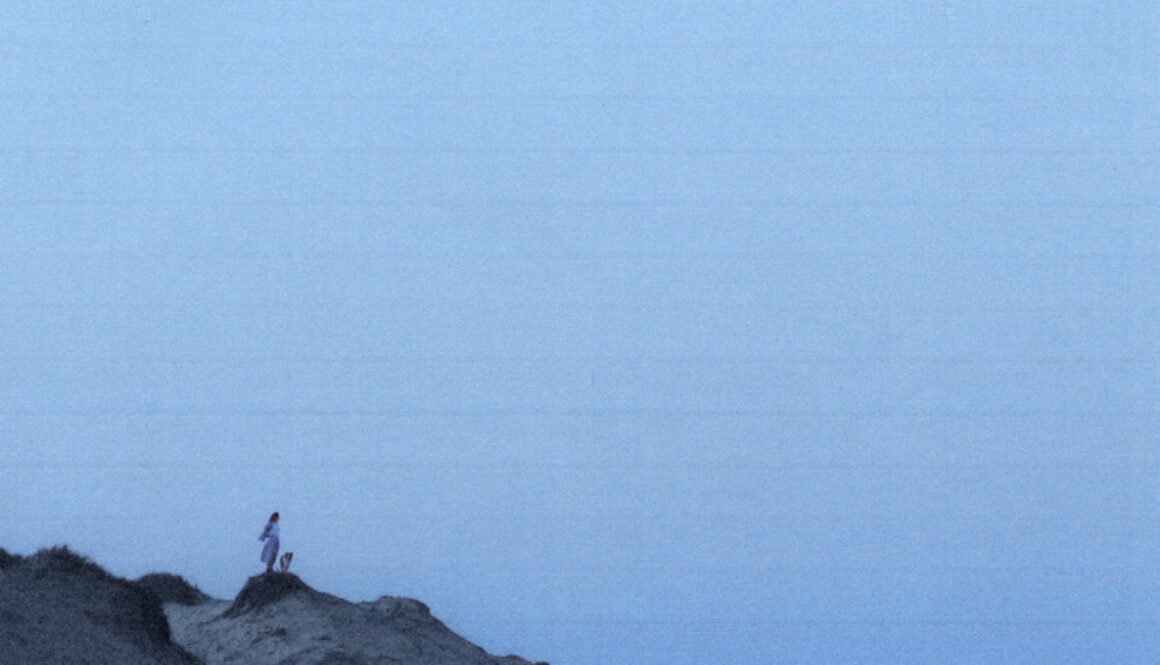
Hana Stretton, “Tiarn” (P.W. Elverum & Sun/Brierfield Flood Press/Lima Limo 2026)
This quietly mesmerizing and unconventional Australian artist has had quite a unique trajectory, as she first began releasing music as Honey Stretton in London back in 2016 and her debut single (“The Thrill of Loneliness”) was a massive hit by indie standards. She followed that success with an EP (Wail) later that same year but soon vanished from public life and moved back to rural Australia to tend the animals on her late grandmother’s farm. While she was alone on the farm, however, she recorded a host of new songs on a nylon string guitar and some borrowed gear while enduring one of the most catastrophic bushfire seasons in Australian history and the rampaging COVID outbreak. Eventually, one of her friends persuaded her to release those new songs and they ultimately became 2023’s Soon album, which resulted in an opening slot on a Mount Eerie tour, international critical acclaim, and a reissue on Phil Elverum’s P.W. Elverum & Sun label. This follow up dissolves her lovely and intimate songs much deeper into ambient abstraction, as it feels like a series of hypnagogic tropical mirages and beachside field recordings mingled with flickering and elusive glimpses of beautifully hymn-like songs.
Tiarn (which means “landholder) was similarly self-recorded in isolation, as Stretton relocated to the small coastal village of Tabourie Lake, where she reconnected to her community by joining a regional choir, observed the migration of whales, and went for regular “blue hour” swims in the South Pacific. All of those elements proved to be significant inspirations, as did a trove of family home movies filmed in Tokyo back in the early ‘90s before Hana’s birth. In particular, Stretton was fascinated by a clip that depicted “distant mountains, and Stretton’s young family looking over the valley in the soft static of one Japanese summer evening” and “a simpler, more connected time.” Armed with a few acoustic instruments and a previously unused synth that her family had purchased during their Tokyo years, Stretton “began recording music directly to that footage – letting the images dictate the melody” and weaving in “voices, insects, weather, movement, and the ambient sounds of the valley.” In essence, this album is a lovingly crafted and impressionistic soundtrack to a hazy and dreamlike VHS dispatch from the blissful time just before her own conception.
The most obvious kindred spirit here is Grouper, as these pieces feel simple, homespun, and deeply personal, but Stretton’s work feels like the sun-dappled and summery negative image of Liz Harris’s stark and nocturnal vision. For me, the piece that most perfectly distills Stretton’s warm, soft-focus dreamworld is “seagull theory II,” which is essentially just stomping and shuffling feet and a looping wordless melody yet it feels organically ecstatic in a way that suggests pure joy and child-like wonder (she even choreographed an imagined line dance for the rhythmic element). That said, it is “stove” that is the album’s most sensuous and achingly beautiful highlight, as a gentle organ loop provides the simple backdrop for a tender swirl of operatic vocals, swooning strings, tape hiss, and the sounds of playing children. It is both heartbreakingly lovely and barely there at the same time, which seems to be a recurring trait for many of Stretton’s finest pieces. I was also quite surprised to learn that the operatic bits were not samples, as Stretton composed a “miniature electronic opera” for vocalist Teresa Duddy and a string quartet and buried it within the album (it also features in the opening “nojiri 1993”).
This genuinely is an album unlike anything else that I have heard, as it feels loose, spontaneous, raw, and poetic in all the right ways despite having only minimal instrumentation and almost nothing resembling a fully formed song (and barely any lyrics either). As Phil Elverum himself puts it, Stretton “has entered completely into the stream where creation originates” and “recorded the deep flourishing sound of a quiet listening mind in full blossom.” A statement like that would normally strike me as overheated press release hyperbole, yet it sincerely seems remarkably insightful and honest here, as Stretton seems to walk home in the dark from her icy swims each day with melodies and ideas swirling in her head and then sets pure magic to tape with just her voice and a few simple instruments.
That sounds like a fairy tale life to me (complete with the dark bits, unfortunately) and living it has enabled Stretton to carve away all the noise and misery of life to get at the fundamental and ineffable joy of simply being alive. More than anything else, the beauty of Stretton’s understated vision lies in her unerring intuition, as sounds feel like they drift in with the ocean breezes before dissipating again and she has somehow found a way to make sketch-like songs feel like a perfect moment captured in time or a flickering reel of childhood memories. It admittedly took me a few listens for all of that to fully seep into my consciousness because Stretton has transcended conventional songcraft to land somewhere considerably more elusive and ephemeral, but music rarely gets more sublime than this.
Listen here.