
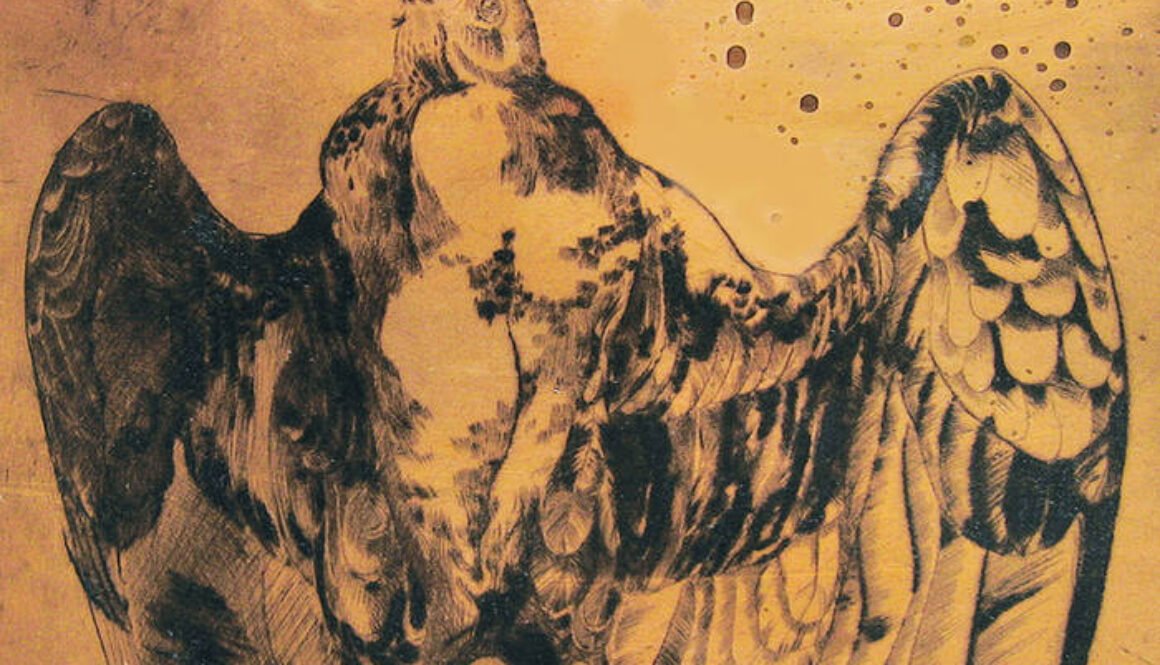
James Blackshaw, “The Glass Bead Game” (Young God, 2009)
James Blackshaw has always been a staggering talented 12-string guitarist, but “The Glass Bead Game” continues his rapid evolution away from his Kottke/Basho-inspired folk roots towards a territory that is more uniquely his own. Of course, there are still a few tracks that fall within the traditional Blackshaw sound (the somewhat underwhelming “Bled” and the extremely beautiful “Key”), but they are largely eclipsed by the warmer and more adventurous tracks that bookend the album.
The opening track (“Cross”) is based upon an elegant arpeggio progression that somehow manages to sound both joyous and bittersweet, but is elevated into otherworldly perfection by the addition of melancholy strings from Current 93’s Joolie Wood and John Contreras and some rather mesmerizing wordless vocals by Lavinia Blackwell. It is an absolutely perfect and heartrending piece and probably the best thing that Blackshaw has ever recorded.
Its closest competition is probably the album’s almost twenty minute long closing epic (“Arc”). Though regrettably marred by a somewhat forgettable introduction, it soon evolves into a masterful and inspired foray into piano-based avant drone. Much like a lot of his guitar work, it is built upon a slowly shifting chord progression composed of incredibly fast arpeggios. The use of a piano, however, allows Blackshaw to cram far more notes into his chords and to sustain them, resulting in a blissful impressionist cascade of smeared notes and unexpected overtones (ably enhanced by his pals from Current 93, of course).
There are a couple of small missteps that prevent this from being an unqualified masterpiece, such as the aforementioned retrogressive “Bled” and the pleasant, but not quite fully-formed “Fix” (which calls to mind both Erik Satie and some of Philip Glass’s soundtrack work). That said, this is still a landmark work by a vital and forward-thinking individual (and infinitely better than the Herman Hesse novel from which it borrows its title). Essential, of course.
Listen here.
(Note: This review was originally published on Foxy Digitalis)