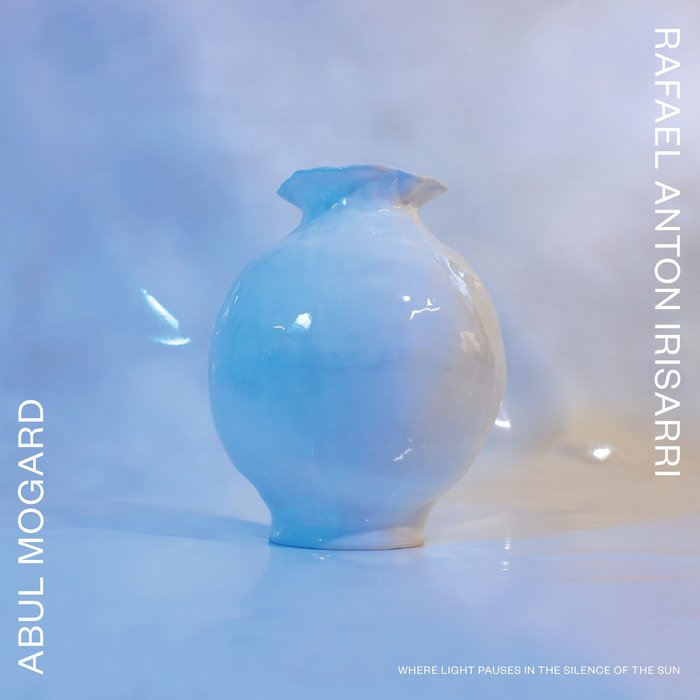
Abul Mogard and Rafael Anton Irisarri, “Where Light Pauses in the Silence of the Sun” (Black Knoll Editions, 2026)
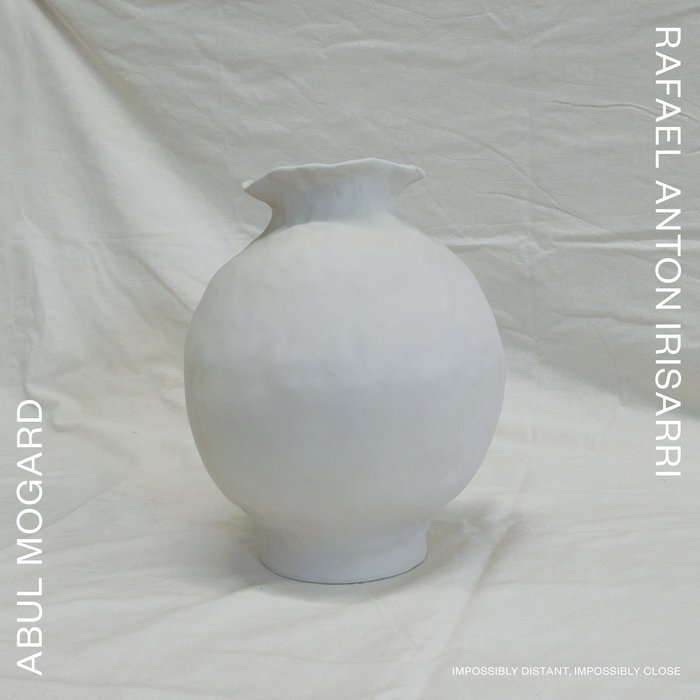
This latest collaboration between Irisarri and Guido Zen’s Abul Mogard alias is billed as the duo’s second album, which admittedly makes sense from a “new material” standpoint, but gets a bit murky given that the duo’s previous releases were a hybrid live/studio album and a live album that featured two previously unreleased pieces. Much like 2024’s Impossibly distant, impossibly close, Where Light Pauses in the Silence of the Sun is again something of a hybrid release, as the raw material was recorded live over a three-day residency at Berlin’s Morphine Raum. Some additional recordings were later made by Irisarri back at his studio in New York, but the more captivating bit is what emerged after Zen layered, subtracted, and reassembled the final recordings at his own studio back in Rome. The result is not what I would have expected, as Irisarri and Zen’s individual styles largely dissolve into a series of unusually minimal and understated mood pieces.
The duo’s palette for these recordings were the expected modular synths and bowed guitars, but there were some unexpected twists this time around as well. The biggest one is that cellist Martina Bertoni and violinist Andrea Burelli share composing credit for a couple of pieces, but I was also a bit surprised to discover that Irisarri’s characteristic veil of frayed and corroded textures is mostly absent. The duo also note that rotary speakers played a central role, as did Morphine Raum’s 1970s mixing console and an array of microphones stationed throughout the room. According to Irisarri, “At moments I genuinely couldn’t tell if a sound was coming from me or from Abul. It stopped feeling like two people making decisions and began to feel like we were inside a system moving on its own.” While I have absolutely no idea how much Abul/Zen later reshaped those performances, I certainly share Irisarri’s sentiment, as the lines between the duo’s synth sounds and processed guitar sounds has never been blurrier. Also, I could have sworn that there was a saxophone in “Blue Descent,” so I may also actually be losing my mind altogether.
In general, these six pieces tend to share a similar arc, as a bleary haze of somber/elegiac synth or synth-like guitar sounds gradually expand into an ephemeral and evocative soundscape before dissipating. However, some pieces definitely let in a bit more human warmth than others and the nature of their transformations can vary quite significantly (particularly when Bertoni and Burelli are involved). For example, the aforementioned “Blue Descent” features languorous sax-like melodies and a few welcome snarls of feedback or bow harmonics, while Burelli’s vocals in the sacred-sounding “In a Quiet Radiance” unexpectedly steers things into a celestial-sounding bliss-out à la Julianna Barwick. The latter is quite a bold detour for Irisarri and Zen, obviously, but it is a strong piece, as it slowly blooms like time-lapse footage of a flower and features some welcome warmth, a violin melody “hook” of sorts, and some smeary brass-like dissonances.
My favorite pieces are a bit more modest in their ambitions, however. For example, the chilled and bleary ambiance “Over The Domes” evokes a lonely seaside on an overcast day, but some of the bass tones are unusually knotty, which creates some cool and interesting harmonies and oscillations. Elsewhere, “Of Blessed Ages” initially feels like a smudgy and gently billowing ambient dream-loop, but then a smoldering and seething undercurrent of distorted drones fades in and ghostly flickers of melody appear and vanish like falling stars. Overall, however, I would categorize Where Light Pauses in the Silence of the Sun as something of a minor or transitional release for both Irisarri and Abul Mogard, as there is nothing here that comes close to scaling the heights of Impossibly distant, impossibly close. Then again, it does not seem like that was ever an objective, as these pieces are all comparatively brief and the duo were clearly experimenting with expanding their circle of collaborators and trying out new working methods. Some of those gambles certainly worked out quite well and there is much to enjoy here, but this one is more for existing fans interested in following the project’s evolution than it is an ideal entry point into either artist’s discography.
Listen here.