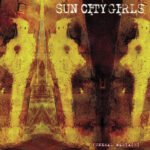
This latest album from Sublime Frequencies co-founder and Cairo-based expat Alan Bishop’s long-running and eclectic solo project is a bit of a pleasant surprise, as he enlisted an absolute murderers’ row of talented collaborators to record a collection of mostly original new instrumental pieces. Notably, the album is billed as “drifting closer” to late-period Sun City Girls albums like Funeral Mariachi, but that kinship is mostly true in a general sense rather than a stylistic one, as Malarial Dream is unusually lean on covers and often feels like the work of a formidable full band. It also mirrors Funeral Mariachi in its comparative listenability, as both Bishop’s solo career and Sun City Girls have their share of prickly indulgences and eccentricities. Obviously, Bishop remains the same idiosyncratic chaos element as always, but Malarial Dream places him at the center of a collection of Middle Eastern-inspired desert-psych jams recorded with an incredible international cast of killer improvisors.
The album opens with the short and punchy “Rock N’ Roll,” which is evidently one of the album’s two “obscure covers,” as Bishop’s Dwarfs of East Agouza bandmate Sam Shalabi is credited as the composer. He also happens to be the one rockin’ the oud in the thorny and droning central riff, but the album’s strongest moments tend to be the less muscular and rock-inspired pieces that follow. In “The Multiple Hallucinations of an Assassin – Part 2,” for example, Bishop and Huda Asfour trade acoustic guitar and lap harp motifs over a pleasantly rolling percussion rhythm and a gently flanging synth drone. Amusingly, Part 2 bears little resemblance at all to the version that appeared on Sun City Girls’ Bright Surroundings, anyone who has been feverishly waiting three decades for its sequel to appear will likely experience some rough cognitive dissonance.
Elsewhere, Bishop’s quavering and chant-like vocals take center stage in the roiling and free-form title piece, but his backing band of cellist Amélie Legrand, violinist Eyvind Kang, and jazz drummer Asher Gamedze certainly do their best to steal the show, as it is easily the album’s most vibrantly alive and almost ecstatic performance. The following “Later” is a killer piece in an entirely different vein, as a different constellation of Bishop’s Cairo guests embark on a slow-burning desert blues number that I would glibly describe as “a more swingin’ Calexico expanded with some hot improvisers.” The reality is a bit weirder and cooler than that, however, as Maurice Louca’s organ playing injects some unexpectedly psych- and prog-inspired flourishes to the Spaghetti Western party. While the best bit is unquestionably Cherif El Masri’s understatedly twanging and smoldering lead guitar, I was extremely impressed with Gamedze’s drumming as well, as he virtuosically enhances the song’s dirge-y groove with a lively array of fills, rolls, and hesitations.
Much like “Malarial Dream” before it, “Later” beautifully conjures the illusion that a winding Cairo alley has just led me into an afterhours club where a shifting cast of stone-cold improv killers from the international underground have convened for a killer all-night psych jam. I suppose it would not surprise me at all if that was exactly how these pieces originated (minus my own presence), which makes me wonder if I missed out on some spontaneous, raw, and more transcendent long-form versions of these pieces that could never be recreated in a studio. For example, I could easily listen to another twenty minutes of the 3-minute “One Month Non-Sexual Vacation in Mongolia,” as the languorous interplay between Cherif El Masri’s electric guitar and Shalabi’s oud is gorgeously meditative and trance-inducing.
While it is certainly easy to envision a stronger version of this album distilled to just extended versions of its four strongest pieces, the main thing that I have learned from following Bishop’s activities for nearly three decades is that only a fool would expect an album of wall-to-wall bangers and fully formed highlights from him. He is the very personification of a loose cannon, as anything (and everything) goes and those listeners who are following his strange and unpredictable journey know that they will always need to sift through a host of weird covers, missteps, loose improvisations, and mystifying experiments to find the gems. I can certainly understand why that is the case, as Bishop has spent his entire adult life subverting conventions, traveling to far-flung places, and finding inspiration in international artists and scenes that most of us do not even know exist. Given that, it is no surprise that his music is rarely a comfortable fit for even the most underground Western sensibilities.
On those occasions when he hits the mark, however, the results can be raw, honest, and beautiful in a truly unique way. To my ears, Malarial Dream’s title piece definitely falls into that category. While nothing else here quite reaches those same rarified heights, there are an unusually high number of hits among these shapeshifting fusions of rock, improv, and traditional Middle Eastern sounds, as well as some compelling leftfield surprises (“Unfinished Business” sounds like a harp-centric live band scoring the opening credits of an especially melancholy giallo film). Also, this album makes a strong case that Bishop is a great bandleader, as he drew quite a lot of talented performers into his orbit and brought out some truly impressive performances as well. As such, Malarial Dream is an unusually solid entry into the Alvarius B canon, as there are definitely a handful of pieces here that rank among Bishop’s most inspired moments.