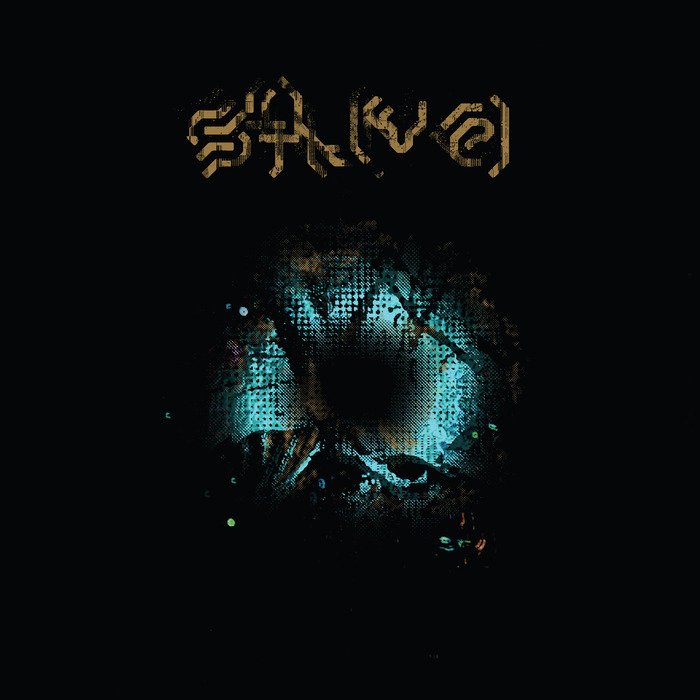
This new full-length from the latest resurrection of Seefeel seems to be the work of just the core duo of Mark Clifford and Sarah Peacock, which is something that would normally present quite a challenge given that the band is now down an entire rhythm section. In the shifting and inscrutable world of Seefeel, however, a formidable obstacle such as that is merely another fresh opportunity for further innovation and evolution. In keeping with that theme, the album’s description observes that Sol.Hz may “be regarded as Seefeel’s ‘dub’ album” in some ways, yet accepting such a categorization requires one to both stretch the meaning of “dub” to its limit and to also downplay all of the dubbier aspects of the band’s previous work. I certainly can see where that claim is coming from, however, as Seefeel has rarely sounded more spacey, impressionistic, and post-modern than they do here: these nine pieces are a kaleidoscopic and boldly minimalist swirl of ghostly ambient washes, repeating vocal loops, and deconstructed rhythms.
It is fitting that Seefeel and Autechre are labelmates, as a fan of either project’s ‘90s work would find their unrepentantly abstract and experimental recent work damn near unrecognizable if they’d just awoken today from a three-decade coma. In the case of Seefeel, only the more “ambient” sounds and (arguably) Sarah Peacock’s voice remain as recognizable signposts from their early days of elegantly blurred, bass-driven, and dub-wise bangers like “Polygonia.” In fact, even the most distinctively “dub” touches of Quique are absent on this latest foray into dub, as are many other crucial features of the band’s iconic first run (any resemblance to rock music, strong hooks, sensuous grooves,etc.). There is a clear through line from 2024’s Squared Roots, however, as the album’s description notes that this material has been similarly “microscopically dissected and reversioned until it reaches the perfect iteration.” The sole significant exception to that trend is the excellent “Falling First,” as seismic sub-bass and an insistently thumping kick drum propel a celestial-sounding swirl of swooning vocal loops and gently flickering and pulsing chords.
Elsewhere, the woozily flickering and pitch-shifting synth flutters of “Ever No Way” are the next closest thing to a hot single, as they approximate a more lurching and pugnacious Boards of Canada. As for the other seven pieces, they ostensibly occupy more “ambient” territory and that is where things get interesting. As the album’s official description again insightfully observes “the deceptively cloud-like arrangements of Mark Clifford are somewhat ambient adjacent at low volume, but blasting out of a proper sound system, the cavernous bass undertow and skillful employment of effects are more apparent, messing with the listener’s perception of time and audio placement.”
In short, volume and immersion are the key to everything here. When Sol.Hz is experienced with the intended degree of intensity, it becomes a unique and visceral experience in which production and sound design sorcery beautifully collide with depth charge kick drums and rumbling bass in a soft-focus haze of elegantly frayed, smudged, and hissing dreaminess. I personally experienced this album via headphones rather than through a sound clash-worthy sound system, so I probably missed out a bit on the seismic bass throb front, but I certainly found that the newly revealed details made the album considerably more compelling For example, “Humidity Switch” is pretty fucking heavy when you can really feel the howling edges of its seasick chords, while “AM Flares” is considerably more beautiful when you can feel the ephemerally flickering and stammering loop at its heart. I also loved the way that the howling crystalline tone in “Until Now” felt like a psychedelic lighthouse beam sweeping across a convulsive and gently bubbling dubscape.
To my ears, moments like those are more than enough to make Sol.Hz a cool album, but the obvious caveat is that Seefeel could probably have unleashed all the same cool sound design tricks on fully formed songs rather than on vamps that feel like a chopped, screwed, and fragmented beat tape. Then again, maybe they couldn’t, as these slow-motion beats leave a hell of a lot of open space between their kick drum thuds and the occasional backwards cymbal pattern and Mark Clifford has undeniably made full crackling and sibilant use of that space. He undeniably had a vision and I cannot say that I have ever heard another album that quite resembles this one. In fact, it often feels disconcertingly spectral and futuristic in a way that makes me wonder what a dub album made by the sentient ocean from Solaris might sound like. Obviously, whether or not that hypothetical release would sound like Sol.Hz is anybody’s guess, but this album definitely would not be a bad act for a gelatinous supernatural mirror of the human psyche to mimic, as its best moments make the air feel like it is practically alive and crackling with electricity.