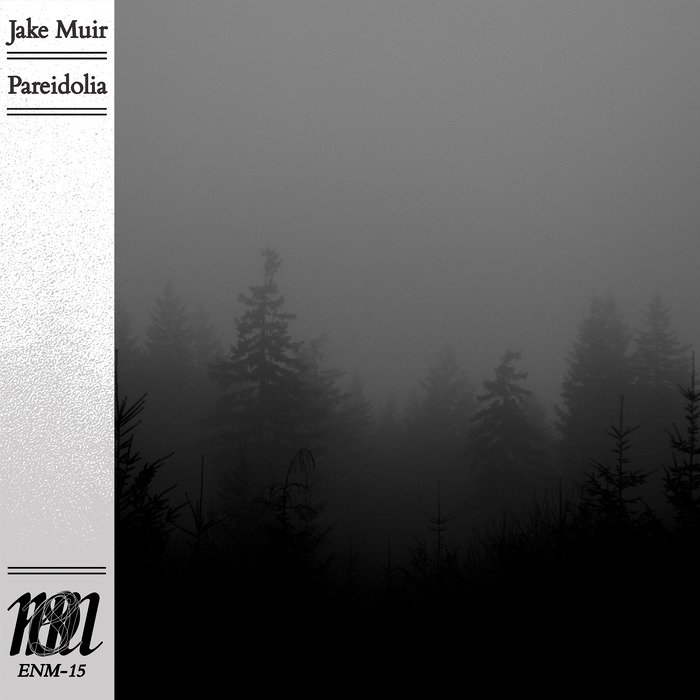
Jake Muir, “Pareidolia” (Enmossed, 2026)
According to the press release, this latest ambitious feat of sonic sorcery from Berlin-based sound artist Jake Muir extracts “the headiest, most atmospheric sections from hundreds of death metal and black metal tracks” to concoct “a lysergic elixir of fractal distortions and prolonged, decelerated riffs that slowly evaporates into iridescent vapor.” In one sense, that is perfectly normal territory for the eccentric Muir, as he has previously transformed bath houses, The Beach Boys, ‘90s illbient, old jazz records, and ancient European church bells into beguiling and immersive psychogeographical sound collages. In another sense, however, Pareidolia is an unusually cold and bleak album for Muir that most closely resembles his collaboration with Barn Owl’s Evan Caminiti.
In fact, Muir’s work on that album (2022’s Talisman) directly inspired Muir’s deep dive into the blackest of metal. While I personally find that this one lands a bit too close to conventional dark ambient fare to rank among Muir’s finest work, he certainly wove some cool transformational magic here and I am very much charmed by the quixotic madness of his intensive sound gathering efforts.
Notably, Muir’s collaboration with Caminiti was the first time that he had ever applied his processing techniques to guitars, which reawakened dormant memories of his teenage metal fandom and sent him in search of “unconventional contemporary metal.” In particular, Muir was fascinated by passages that “seemed to hover between different realms, merging frenetic, noisy sections with psychedelic interludes that harmonize with classic industrial and avant-garde music like Zoviet France, Nocturnal Emissions and Z’EV.”
To my ears, the music that ultimately resulted from Muir’s blackened and macabre collage frenzy bears little stylistic resemblance to any of those artists, but I can see how the exotic imagined worlds of Zoviet France’s “sci-fi tribal” vision may have been an inspiration. While there is nothing particularly sci-fi or tribal about Pareidolia, it does evoke a similarly otherworldly tableau of wintry Carpathian forests and dark rituals. That is pretty much where any resemblance to black metal ends as well, so any heads hoping to identify Muir’s source material will likely come up empty, as there are no discernible riffs or vocals to be found at all—only grayscale ambient nightmares with vivid sound design. Then again, one feature of pareidolia is the perception of meaningful patterns in ambiguous auditory stimuli, so anything is possible.
To my ears, the strongest piece is “Celestial Visions,” as warm, ephemeral chords organically undulate like slow-motion footage of a jellyfish and deep exhalation-like sounds vibrantly pan through space. There is also some ghostly feedback near the end of the piece that makes the air feel darkly shimmering and alive. The rest of the album can reasonably be described as seven more (somewhat colder) variations on roughly the same theme (mysterious shapes forming in a haunted supernatural fog), yet the nature of Muir’s illusions varies in compelling ways from piece to piece. For example, the roiling, hissing, and howling ambiance of the opening “Beithir” initially suggests an evil wind blowing through a cold leafless forest, but blossoms into a haunting crescendo of smeary and hallucinatory bird songs. The following “Necrotic Mist” also feels disturbingly bird-centric, as its viscous and undulated haunted jungle ambiance evolves into a stretch that resembles screeching and swooping metallic nightmare birds in a vast and echoing cistern.
Elsewhere, “Unholy Apparitions” conjures a buzzing and gurgling hallucinatory frog pond on a humid summer night, while the grey landscape of breathy drones and rainstick crackles of “Oblivion” unexpectedly blooms into smeary, jungle-like swells that remind me the moment in Tarkovsky’s Stalker when the film dramatically changes to color. I also loved the way that Muir managed to make seagulls and crashing waves sound sinister and unreal. In fact, the trippy sonic sorcery that Muir applies to his sounds is genuinely the best part of the album, as it often feels like time has unnervingly slowed, sounds feel uncomfortably viscous, and acoustics feel eerily alien and unfamiliar. I was also very impressed with how beautifully Muir balanced dreamlike murkiness with sharper textures that viscerally carve through that fog. While Muir is unquestionably at his darkest and least playful here (this is probably as far as you can get from The Beach Boys), Pareidolia is an exquisitely crafted frozen nightmare of an album.
Listen here.