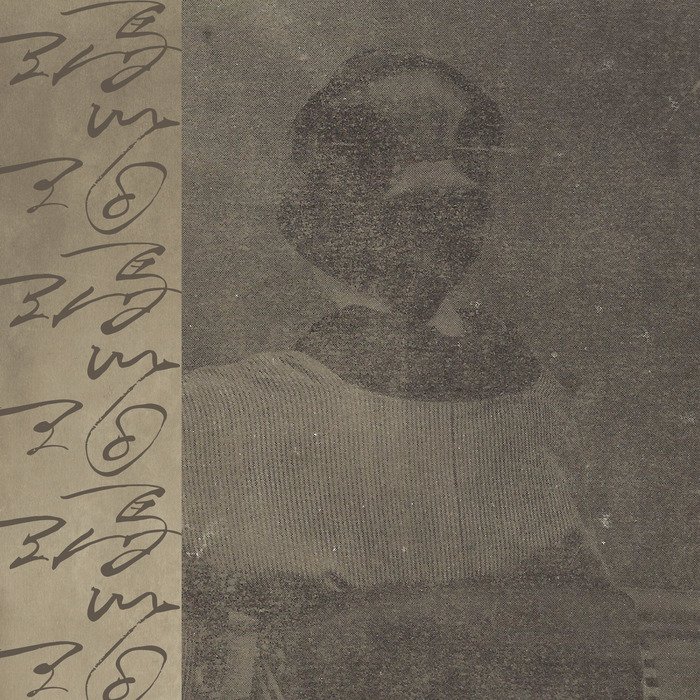
Meitei, “Agate” (Kitchen, 2026)
This latest stunner from Japanese artist Daisuke Fujita’s Meitei alias seemed almost impossibly great the first time that I heard it, but that made sense once I learned that it was essentially a collection of ambitiously reworked pieces from his earlier Kofū trilogy. These are more than alternate versions, however: they are perfected versions, as five years of touring behind Kofū sharpened and reshaped Meitei’s instincts regarding “pacing, dynamics, and structure” to a truly formidable degree. The album’s title alludes to yet another evolution, which the label summarizes as “If the Kofū albums were windows into forgotten eras, Agate explores what lies beneath…Grains become texture. Texture becomes narrative. Voices drift through decaying layers of sound, while ancient instruments are used in non-traditional ways.” In short, Agate is Meitei’s masterpieces, as all of the project’s most inspired motifs are now distilled into a gorgeously hallucinatory swirl of killer obscure samples that vibrantly hiss and crackle with life.
Meitei summarized his vision for the three Kofu albums as an attempt to evoke a “lost Japanese mood,” as he used “fragments of folklore, theatre, ghost stories, and forgotten urban memory” to reflect “a sensibility of the past observed from the present.” While all of those elements remain present on Agate as well, Meitei now describes his art as “Shinpu, a process of discovery in which historical awareness becomes a foundation for contemporary creation rather than a constraint.” I can understand his desire to clarify that point, as Meitei’s repurposing of dusty forgotten records and traditional instruments bears zero resemblance at all to a backwards-looking pastiche. In fact, I would describe Meitei as the absolute cutting edge of sample-based music, as his wild juxtapositions, complex layering, and razor-sharp editing have few peers outside of the most virtuosic techno producers. When Meitei hits the mark just right, the results are absolutely mesmerizing, boldly original, and damn near untouchable.
In that regard, “SHIN-OIRAN” is the piece that best captures Meitei at his awe-inspiring zenith, as he expands and reinvents Kofū’s “Oiran I” into a dizzying swirl of haunting vocal samples, smeary psychedelia, jazzy piano, propulsively shuffling grooves, and rubbery bass lines. Every single passage is exploding with cool melodies and rich details and they all flow together beautifully—especially whenever it snaps back into the central theme. Meitei’s incredible craftsmanship is evidenced yet again on the following “SHIN-SADAYAKKO,” as a repeating sample of “people, Japanese people” anchors a vibrantly hallucinatory fantasia that is continually transforming while breathlessly rushing forward at a delirious pace…most of the time. At other times, it slows, pauses, or hesitates before diving back into its hypercaffeinated forward momentum, which is an extremely effective tactic. I can’t think of any other artists who so seamlessly and nimbly stretch, bend, speed up, and condense time within the same piece.
Elsewhere, “SHIN-OIRAN II” (another variation on Kofū ’s two-part “Oiran”) is another dazzler, as an intricate web of piano melodies ripple and dance into infinity beneath crackling string loops while the piece slowly gathers steam. Notably, this latest version of “Oiran II” stretches the original piece’s four-minutes into a richly textured eleven-minute tour de force of ascending vocal hooks, dramatic choral samples, masterfully interwoven flute and piano motifs, weirdly funky martial percussion, and throbbing bass. The closing “SHIN-EDOGAWARANPO” is similarly wild, as frayed, smeary, and blown-out motifs have Muslimgauze-style dropouts en route to a bubbling and convulsive crescendo of mindfuckery that sometimes resembles an out-of-control psychedelic merry-go-round.
On the less maximalist end of the spectrum, “SHIN-SADAYAKKO” weaves magic from little more than a bittersweet and beautiful architecture of simple piano loops, backwards drones, and an undercurrent of mysterious hiss-ravaged samples. That said, every single piece on this album is mesmerizing, immersive, and gorgeously psychedelic in all the right ways. While a few pieces admittedly lay on the drama a bit more than I would like, there isn’t a single one that is not brimming with great hooks, surreal atmosphere, vividly realized textures, and a host of bold and unexpected collisions of themes. My man was really on fire this time around. Consequently, I have no hesitation in stating that Agate is Meitei’s finest album by a landslide and quite possibly the most perfect headphone album of 2026 as well.
Listen here.