
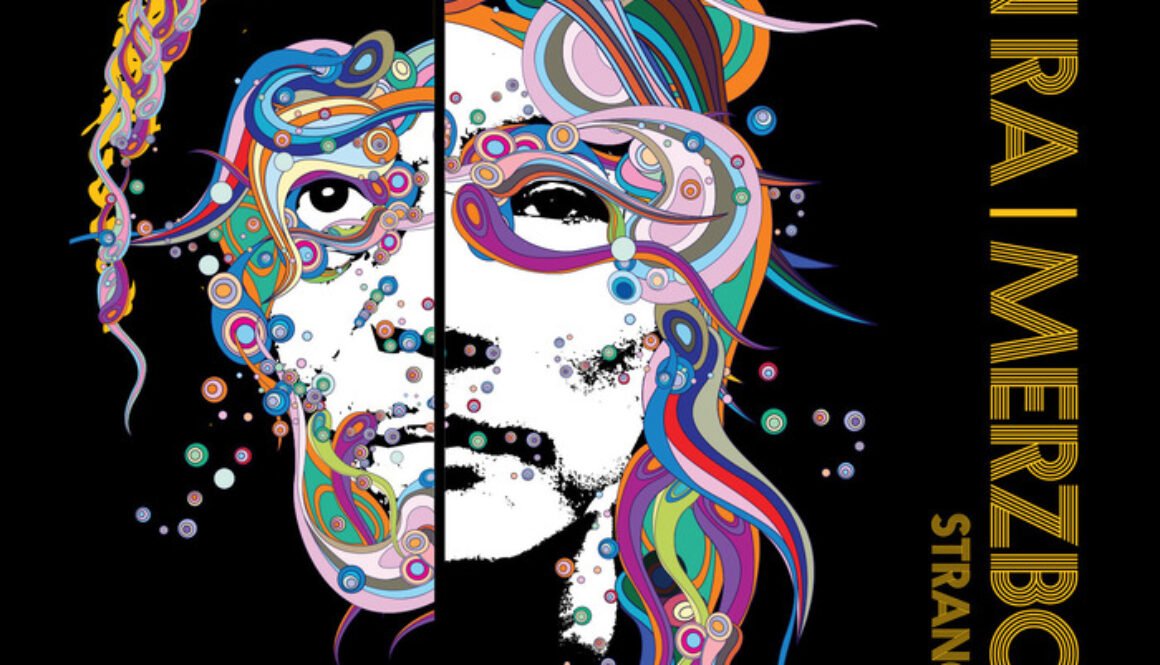
Sun Ra | Merzbow, “Strange City” (Cold Spring 2016/2026)
This wild album was first released a decade ago, but it is now back again in a new form, as the previous release was essentially two completely different albums depending on whether you chose the vinyl or CD format. This double CD now unites those divergent releases into one and also throws in a short bonus track that was created for Stuart Marconie’s Freak Zone show on BBC Radio 6. Weirdly, I am not entirely clear on the provenance of the Sun Ra material being remixed here, as Cold Spring mentions that they had licensed rare/unreleased recordings from Sun Ra’s estate for this project, but they also seem to be culled from the Strange Strings & The Magic City albums. Also, Merzbow’s “remixes” characteristically obliterate damn near everything in their path, so Strange City is pretty lean on recognizable Sun Ra bits. In spite of that “scorched earth” tendency, however, my favorite Merzbow albums do tend to be those in which Masami Akita is (violently) jamming along to music that he loves (Aqua Necromancer, Doors Open At 8 AM) and Strange City is an absolute all-time classic in that realm. Unsurprisingly, I also wondered if transforming a single album into a double album would yield diminishing returns due to the numbing effect of being continually blasted by harsh noise for more than an hour, but all six of these tracks are absolute scorchers.
For my money, the fans who chose the CD over the LP back in 2016 definitely got the better end of the deal, as the CD’s two longform pieces are undeniably the best part of this release. In fact, I think Strange City would still be an instant-classic Merzbow release even if it was reduced to just the 32-minute “Livid Sun Loop” alone. That said, I sincerely doubt that anyone at all considers this to be an important Sun Ra release, as the Arkestra’s skwonking sax hook is predictably vaporized by a howling cascade of noise within the album’s first ten seconds. While that same sax hook admittedly surfaces again and again, the Arkestra’s presence is usually reduced to little more than a snatch of a bass line, some buried vocals, a looping sax squawk, a squealing string motif, or a ride cymbal or upper-register piano note that fleetingly rings out over the roaring cacophony. Some wild drumming occasionally creeps into the scene as well, but it is usually so blown out and distorted that it is more felt than heard and is largely indistinguishable from the sounds of an idling motorcycle.
Naturally, that unavoidably begs questions like “does it actually matter which Sun Ra recordings were used?” and “why even drag Sun Ra into this album at all if he’s going to be completely obliterated?” The main answer seems to be “because Akita found those albums inspiring,” but the rare occasions in which the Arkestra fights their way back into audibility also make a welcome oasis from Akita’s face-melting onslaught of harsh noise. The Arkestra bits also give this album the feeling of a volatile tug-of-war between order and chaos that would otherwise be absent. I also find it weirdly endearing that jazzier sounds keep bubbling out of the maelstrom, as it feels like Akita stepped up to the mic to take a solo and proceeded to reduce the club and the surrounding city to smoldering rubble with an apocalyptic noise eruption. Regrettably, I do not know of a vegan-friendly alternative to “you need to break some eggs to make an omelette,” but Merzbow clearly needed to eviscerate an icon to make this album and I believe the end justified the means.
While I would describe my current level of Merzbow fandom as casual at best, I have been listening to him since his great run of Relapse albums hit the US in the mid-‘90s, so both Akita’s volcanic power and arsenal of sounds are extremely familiar to me. However, I attempted to listen to this latest installment of Strange City with fresh ears and was pleasantly surprised to encounter at least one legitimately striking and memorable passage in each piece. For example, “Livid Sun Loop” sometimes sounds like a thousand gibbering mouths of hell, but there are also stretches where a looping sax lick becomes an insistent alarm sound or where it sounds like a female voice is drifting through a spaced-out squall of lasers. Elsewhere, the album’s other towering highlight (“Granular Jazz Part 2”) features several passages that sound like psychedelic alien birdsongs, while “Granular Jazz Part 3” fitfully sounds like both a lysergic arcade and a demonic carousel.
While the two longform pieces undeniably steal the show, the shorter pieces hit quite hard as well and contain enough cool ideas to justify their inclusion. Even the new 2-minute piece (“Granular Jazz Part 5”) does not seem like filler, as it now feels like the album decisively ends with a stuttering, howling, and visceral percussive blizzard. Obviously, two full discs of Merzbow is still a punishing and numbing amount to absorb in one sitting, but any one of these pieces feels like a satisfying stand-alone experience. Obviously, it is extremely easy to take Akita’s work for granted at this stage, as most of Merzbow’s 500+ releases sound largely interchangeable to anyone who is not a serious harsh noise head, but one could probably say the same about John Coltrane (“another fucking sax solo?!? I thought he just did one!”). Akita just happens to be working with a completely different musical language in which familiar landmarks like melodies, hooks, and grooves do not exist. Instead, there is only some of the most vibrantly, ferociously alive music ever recorded.
In fact, one might even call it ecstatic. While Akita may be monomaniacally devoted to a very specific sound and one volcano of screaming noise chaos can sound a lot like another if you don’t listen particularly deeply, I was legitimately struck by how beautifully, organically, and spontaneously Akita’s unrelenting noise attack flowed here: some of the individual passages were certainly great, but I was far more blown away by the shifting frequencies and textures and the way that Merzbusiness-as-usual could unexpectedly and viscerally collapse, dissolve, or implode into a spray of lasers, rhythmic bursts of static, eerie whistles, a swirl of lysergic seagulls, or a field recordings from an infernal casino. I can certainly understand why some fans find it exasperating that Sun Ra and his Arkestra are almost instantly incinerated by a wall of howling noise intensity, yet Akita’s endlessly evolving tsunami of entropy remains unwaveringly mesmerizing long after the shock of its elemental power subsides.
Listen here.