
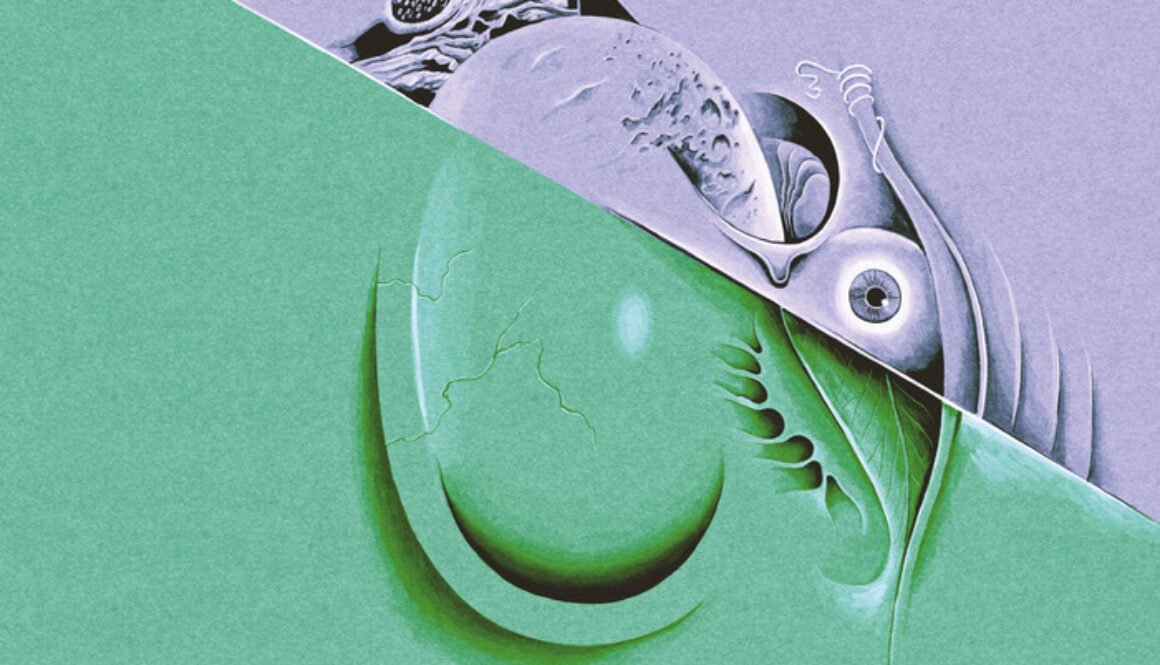
Razen “Stained Glass Starling” (Viernulvier, 2026)
The latest album from this eclectic and eternally evolving Belgian collective is a collaboration with veteran Dutch composer/theater musician Dick van der Harst. This is not the first time that Razen’s Brecht Ameel and Kim Delcour have worked with van der Harst, however, as the three artists have been fitfully crossing paths in Belgium’s avant-garde theater scene for a couple of decades now and have previously worked together on a couple of Eric De Volder productions. This is their first album together, however, and it is a match made in heaven, as van der Harst’s “vast arsenal of rare and historical instruments” and formidable improv chops elevate Razen’s “modal mysticism and otherworldly trance-like traditional music” to an impressively sublime and vividly alive new plane.
For these recordings, Razen was a quintet rounded out by Berlinde Deman (serpent, bass tuba) and Paul Garriau (hurdy-gurdy) and the sessions took place in the living room of producer David Poltrock. Notably, all of the instruments involved were entirely acoustic and these five pieces were mostly first-take improvisations “with minimal cues discussed beforehand” (though there were a few overdubs as well). In short, familiar territory for Razen. In the wrong hands, such an approach is often a recipe for interminable and half-baked meandering, yet Razen function with an almost supernatural “hive mind” chemistry here that extends to every single aspect of these performances. Melodies, harmonies, textures, atmospheres, you name it—everyone here was unquestionably locked onto the same cosmic wavelength.
On one level, of course, it is comparatively easy to achieve perfectly harmonious constellations of instrumentation over a meditative backdrop of harmonium drones. On a deeper level, however, Razen beautifully transcend the expected terrain, as the core musicians fluidly interweave haunting Middle Eastern and Asian melodies played on a host of unusual instruments without ever stepping on each other’s toes or wandering off-course into indulgent solos.
Unsurprisingly, the opening 17-minute title piece is the beating heart of the album. It’s one of the album’s most drone-centric and Middle Eastern-flavored pieces as well, as van der Harst unleashes an endlessly evolving and heavy-hearted melody on his erhu, which is a two-stringed Chinese bowed instrument with a python skin-covered resonator. Yet another unusual aspect of the piece is that it is rooted in a mode developed by French composer/ornithologist Olivier Messiaen “who famously translated color into harmony and birdsong into musical notation.” I bring that up solely because my favorite part is a stretch in which van der Harst veers into a textural flurry of scrapes, squeaks, squeals, and chirps that resemble a wild psychotropic birdsong. The whole piece is a slow-burning tour de force though, as Delcour’s woodwinds increasingly intertwine with the erhu melody and Ameel’s harmonium drones gradually become more buzzing, psychedelic, and harmonically complex while the central theme organically recurs again and again like a guiding thread.
The other four pieces are a bit shorter yet no less substantial and unique. My favorite is currently “Starling Gut,” which is an absolute feast of visceral, snarling, and gnarled textures wrested from van der Harst’s tromba marina (a medieval bowed string instrument). Elsewhere, “Jalak Bali Egg” is a highlight in a very different direction, as Delcour’s melancholy woodwind melody floats above a vibrantly dancing and rippling arpeggio motif played on a Javanese harp called a kacapi (van der Harst’s family hail from the the former Dutch East Indies). Impressively, the remaining two pieces are on a similar level, as “Murmur Murmur” sounds like a languorous Middle Eastern-flavored saxophone duel summoning a burning sunrise, while the brighter, more free-form closer “In The Reeds” expands beyond drone in radiant, spontaneous, and unpredictable ways.
Cumulatively, the five pieces add up to an unwaveringly compelling and immersive whole filled with lively and dynamic melodic interplay, ritualistic drone atmospheres, and an impressive number of sounds and sound combinations that were previously unfamiliar to my ears. That last bit is especially crucial, as the full beauty and magic of this album did not reveal itself to me until I threw on some headphones to immerse myself fully in the physicality of every breath, bow scrape, sharp harmonic, or oscillating dissonance. That secret world beyond casual listening is where this album truly came alive for me. While I cannot pretend to have a comprehensive command of Razen’s expansive oeuvre to date, I have been casually following their activities for roughly a decade now and this definitely feels like one of the project’s most focused, absorbing, and beautifully constructed statements.
Listen here.