
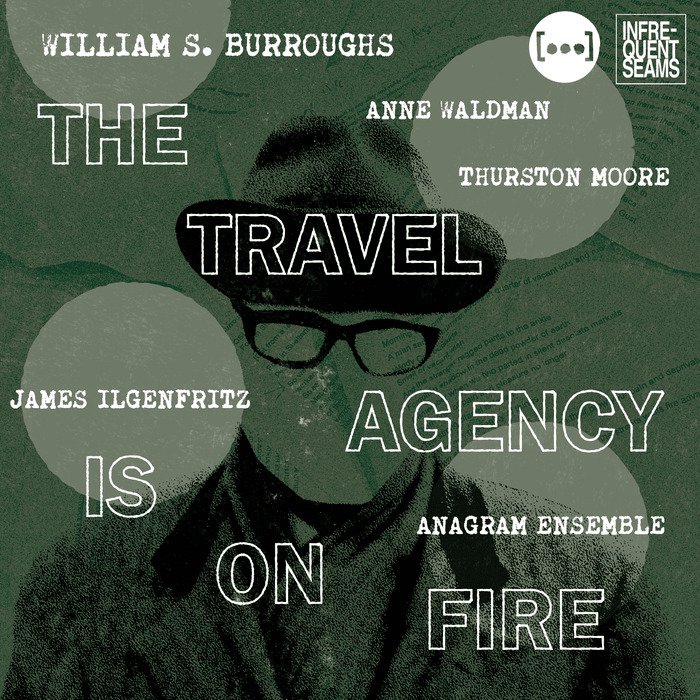
“The Travel Agency Is On Fire” (Infrequent Seams, 2026)
This fascinating and ambitious boxed set is a star-studded celebration inspired by a trove of previously unpublished cut-up works by William S. Burroughs unearthed by Burroughs scholar Alex Wermer-Colan in 2015. The project’s other central figures are composer James Ilgenfritz, poet Anne Waldman, and Thurston Moore (albeit mostly in spoken word mode). Notably, this is Ilgenfritz’s second major work devoted to Burroughs, as he previously composed a video opera for The Ticket That Exploded back in 2011. While Ilgenfritz’s Anagram Ensemble returns again here, The Travel Agency Is On Fire is otherwise a VERY different animal than its predecessor, as it features guest contributions from a number of NYC avant-garde luminaries (Jim Thirlwell, Zeena Parkins, Elliott Sharp, etc.) as well as an entire disc in which many of those contributions are compellingly chopped up and recontextualized by Ilgenfritz. While Burroughs is ostensibly the star here (for the first two discs, at least), this collection’s best moments transcend the original objective entirely and feel like nothing less than an immersive and impressionist sound collage that drops listeners directly into the heart of NYC’s mid-20th century avant-garde golden age.
Like many radical and unconventional art concepts, the cut-up has its original roots in the Dadaist movement of the 1920s, as Tristan Tzara composed spontaneous poems at a rally from random words pulled out of a hat, then later published his cut-up instructions as “How to Make a Dadaist Poem.” Unsurprisingly, Tzara was a bit ahead of his time and the technique did not catch on until it was rediscovered by artist Brion Gysin in the 1950s when he accidentally cut through some newspapers with a razor blade. Fatefully, he introduced his friend Burroughs to the technique at Paris’s Beat Hotel and the idea gradually blossomed into something much larger, as the two soon expanded the technique to include audio recordings.
Over the years, of course, Burroughs published several influential works that utilized his cut-up techniques, such as his Nova Trilogy (The Soft Machine, The Ticket That Exploded, and Nova Express), but he also viewed the technique as a form of divination not unlike John Cage’s I Ching-inspired work. As Burrough’s himself put it, “When you cut into the present the future leaks out.” History has proven that to be an impressively solid prophecy, as the technique has since become an absolutely integral feature in a number of artistic disciplines. In music alone, for example, it has since been embraced by everyone from David Bowie to Radiohead and is now basically hard-coded into the DNA of all contemporary hip-hop and electronic music.
That evolution is most ingeniously channeled by Ilgenfritz on the opening disc of The Travel Agency Is On Fire, as he collages and recontextualizes source material from an array of small jazz/improv ensembles featuring artists like William Winant and Daniel Carter. The second disc is devoted to more composed pieces recorded by a more post-industrial/electronic-leaning milieu of artists that includes JG Thirlwell, Mark Trecka, and Bob Bellerue. The remaining two discs are composed of the many instrumental pieces that ultimately served as the grist for Ilgenfritz’s sound collages and tend to fall into more conventionally “jazz” terrain (which makes sense, given that there are five different saxophonists involved in this project). While I am personally more drawn to that material in its collaged final form, I genuinely appreciate how the emphasis on jazz evokes Burroughs’ own mid-20th century cultural environs while the “collage” aspect recontextualizes everything with a fresh and contemporary twist.
Notably, my expectations for this album were initially somewhat modest, as I am only a casual Burroughs fan and I envisioned a series of straight readings of Burroughs’s texts backed by largely improvised music. In theory, I was not entirely wrong, but only the opening “Man Like Goodbye” feels like it fully lands at that baseline, as Waldman reads a Burroughs piece over a twinkling and creaking ambient backdrop of Moore’s guitar. However, even that piece gradually becomes a bit gnarled, kaleidoscopic, and convulsive by the end.
While Moore takes over vocals himself for the following “Fading Violins of Autumn,” the best pieces on the first disc (and overall) tend to be those in which Moore’s straightforward readings intertwine and overlap with Waldman’s more emotive and performative interpretations (especially when her voice is chopped up and reshaped with a host of effects). The finest example of that approach on the first disc is probably the shapeshifting “Jack Kerouac Come In Please,” which gradually drifts from murky and Lynchian saxophone noir to a slow-motion maelstrom of rhythmic howls, distorted vocals, and overlapping voices. I also enjoy how the comparative intensity of Waldman’s performances imbues many of these pieces with an unpredictable and half-crazed volatility (and it contrasts quite nicely with Moore’s more understated and matter-of-fact approach).
While other highlights from the sound collage-centric first disc include “Implacable Hostility,” “Alien On Tracks,” “What He Did Not Know,” “They Were Projecting The Ray Of Their Love Into Infinity,” and “Soil Linen Land,” the differences between the individual pieces are less significant than the cumulative effect of being fully immersed in the vivid, unpredictable, and disorienting cacophony of Ilgenfritz’s soundscapes. In fact, the entire disc feels like a wild and shapeshifting fever dream in which enigmatic and unconventional poetry collides with shards of recontextualized subway saxophonists, free jazz skwonkfests, operatic vocals, noise squalls, stammering loops, chromatic piano abuse, clattering drums, buzzing and juddering electronics, panning jackhammers, distorted radio signals, and ghost transmissions from the other side.
On the second disc, Waldman and Moore are generally backed by more ambient-minded fare. There are a few notable exceptions, however, such as JG Thirlwell’s pounding and throbbing “Like Invasion Now Not Practice” or Mark Trecka’s chopped up vocal performance in “Truckloads of Angel Hearts.” Musically, I was most impressed by Trecka’s piece, Dustin Krcatovich’s crackling and hissing textures, and the heavy drone of Bob Bellerue’s “Heat Lightning” (which sometimes sounds like a time-stretched siren or car alarm), but the larger appeal is that the more understated backdrops of the second disc shift the focus more towards Burroughs’ words and there are a number of striking and poignant turns of phrase scattered throughout its pieces.
In general, the topics drift towards familiar Burroughs’ subjects like sex, viscera, romantic longing, disease, and scathing societal critiques, but there are many snatches of eerily evocative poetry as well (like “the carousel was playing ‘Smoke Gets in Your Eyes’” or “the waiting mouths of paradise”). While my favorite line is unquestionably the hilarious “they were projecting the ray of their love into infinity that has never known the stain of female flesh,” there is no shortage of other hot contenders such as “taste the shit of futurity.” Moreover, the same lines keep resurfacing throughout the album in new contexts, which gives everything the surreal feel of an endlessly looping Mobius strip. Anyone concerned about the state of the titular travel agency will not be disappointed at all in the frequency of fresh updates (spoiler alert: it is always on fire). I also did not expect either Burroughs’ words nor Moore and Waldman’s performances alone to be quite so mesmerizing (particularly on the downright incantatory “Thrilled With My Deathlessness”).
For me, however, it is very much the first disc that most perfectly captures the soul and vision of this project, while the other three discs feel like a deeper dive for those craving more (though the second disc certainly has its own share of great moments). The reason for that is quite simple: James Ilgenfritz totally blindsided me with an absolute tour de force of sound collage mastery. In lesser hands, this collection could have easily felt like an academic museum piece, yet Ilgenfritz gamely used Burroughs’ own technique to transform a handful of belatedly discovered writings into something that feels spontaneous and vibrantly alive.
That said, it is also quite interesting to hear the unedited source material that Ilgenfritz started with so that I can fully appreciate the scope and vision of his transformations. Also, some of the instrumental pieces make for cool stand-alone works in their own right. I personally enjoyed AC Diamond and Kerosene Jones’ buzzing and stammering electronic weirdness the most, but I suspect serious fans of the jazz /improv scene will find far more to love on the instrumental discs than I did.
In any case, this collection feels like an unearthed time capsule that has supernaturally come alive and plunged me into a wild late ‘70s loft party teeming with poets, painters, eccentrics, jazz heads, performance artists, playwrights, classical music iconoclasts, no wave contrarians, and eclectic freaks of all stripes. From where I am standing, that is quite a fascinating world to be immersed in and it is a sufficiently complex and multilayered experience that it does not yield diminishing returns with repeat listens (nimbly avoiding the curse of most other spoken word-themed albums). While I dearly wish I could say that I RE-immersed myself in that world instead (I missed NYC’s countercultural golden age by a wide margin), I suspect that Ilgenfritz’s collages conjure a wonderfully dreamlike version of that world that distills all the best bits while cutting out all the bad bits and those bits that were not worth remembering. The Travel Agency Is On Fire is an absolute revelation that is every bit as much of a love letter to a lost NYC as it is a love letter to Burroughs himself (and it is also quite a bit more than that as well).
Listen here.