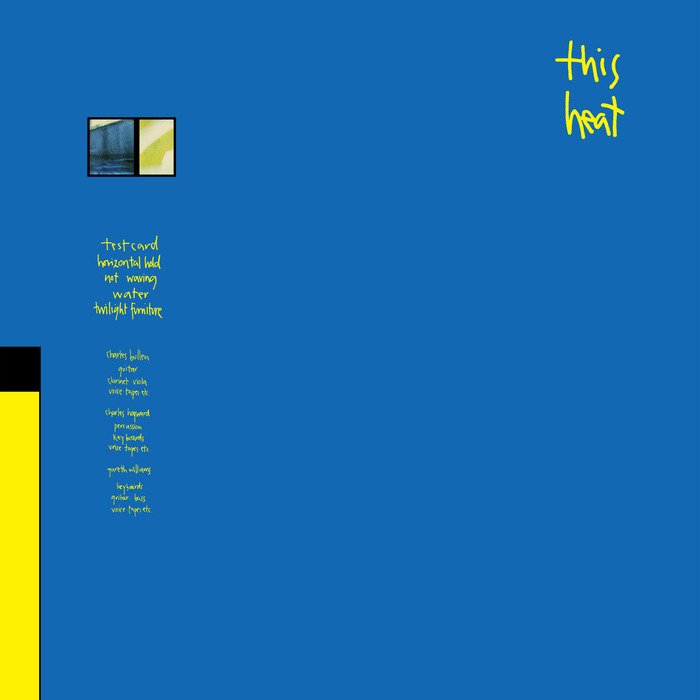
This Heat, “This Heat” (Piano 1979/Superior Viaduct 2026)
Newly reissued on Superior Viaduct and their own newly minted imprint, This Heat’s 1979 debut remains one of the most radical and influential opening salvos in underground music history. Notably, this trio of multi-instrumentalist Charles Bullen, drummer Charles Hayward, and visual artist/non-musician Gareth Williams formed the same year that Throbbing Gristle first made their public debut (1976), but This Heat came together under very different circumstances, as Bullen and Hayward improbably met as members of Phil Manzanera’s short-lived prog band Quiet Sun while it was reactivated during a break in Roxy Music activities. While that Quiet Sun album has since become a cult favorite in its own right, Roxy Music soon dragged Phil Manzanera away again forever and they never released anything else.
That was a tough break, but those prog roots are a fascinating part of This Heat’s origin story. In fact, Hayward also had another pre-This Heat project with a member of Henry Cow (Radar Favorites). While the motley crew of performance artists, outsiders, and provocateurs that became Throbbing Gristle were always destined to become wreckers of civilization, This Heat were essentially just two guys with prog chops and a major label record deal who boldly decided to start making confrontational and unpopular music with their artist friend in a fucking disused meat locker instead.
To my ears, this era of This Heat shared a lot of common ground with Faust, as the band were constantly rehearsing and recording in isolation and had a similar love of cut ups, tape manipulations, kaleidoscopic collage, and general sonic fuckery. Unlike Faust, however, who had their own studio built in a former school in the German countryside (financed by a hapless major label), This Heat spent eight hours a day in a windowless bloodstained cooler in a former meat pie factory (albeit one with great natural acoustics). Given that, I suspect Cold Storage was just as influential as any individual band member in shaping This Heat’s sound, as the trio’s daily ambiance was grotesque, dark, industrial, and alienating and that really came through in their music. As such, it is hardly surprising that This Heat did not sell particularly well upon its release, but it has since followed roughly the same trajectory as The Velvet Underground’s similarly unpromising debut. To paraphrase some guy from Phil Manzanera’s other band (Brian Eno), not many people heard this album, but it sure seems like absolutely everyone who did soon went on to start a band of their own.
After a brief introduction that sounds like a Morse code transmission, “Horizontal Hold” explodes from the speakers with a heavy drum stomp, groaning bass slides, and wild squalls of dissonantly jangling guitars and sputtering electronics. As far as opening statements go, “Horizontal Hold” is pretty hard to top and remains the song that I immediately think of first whenever this album comes up. Gradually, however, the jam gradually expands into messily dissonant guitar soloing, queasy organ drones, uncomfortable harmonies, and spews of electronic noise, but the most jarring and inventive bit is how the band seem to bounce between very different room tones. It feels like two divergent realities are bleeding into one another while everyone involved tries to be as far out and subversive as possible in their rock deconstructionism. There is also a surprising and endearing degree of willful naivety/primitivism in the band’s playing (aside from the drums), as there are several bits that feel deliberately clumsy or wrong in a way that suggests that Bullen had only recently taught himself how to play the guitar.
To some degree, the following “Not Waving” is a bit more conventionally song-like, as there are quavering chant-like vocals, but the vibe is considerably more darkly lysergic and ritualistic and it still feels like a deeply alien heavy psych nightmare even by 2026 standards. In fact, it is pretty easy to see how “Not Waving” was likely a big influence on early Coil albums like Scatology and Horse Rotovator.
While the rest of the album continues that trend and comes pretty damn close to being an unbroken string of bangers, the most striking highlights are “24 Track Loop” and “The Fall of Saigon.” In the former, the band wildly and playfully make the most of their multi-track recording capabilities, as Hayward’s breakbeat drumming unpredictably bounces in and out of the foreground while being strafed by detourned exotica organs, robot voice-like textures, pitch-shifts, and jazzy skwonks. It may also be the single most prescient piece on the album, as some aspects anticipate ‘90s jungle by a couple decades. “The Fall of Saigon,” on the other hand, is simply an extremely cool song, as it combines heavy drones, tribal industrial percussion, and a strong vocal melody before blossoming into something approximating a slow-motion blues solo with deliberate wrong notes, confused rhythm, and animalistic noise swells. Notably, it is also one of at least two songs that was later lovingly appropriated as a band name by This Heat’s many descendants (Not Waving being the other).
Beyond the obvious hits, however, the album is also fascinating due to the eclectic scope of This Heat’s influences, as they incorporated shades of “free jazz, Captain Beefheart, musique concrète, and reggae’s disorienting dub techniques” and consistently did so in unpredictable and surprising fashion. In fact, I suspect that is just the tip of the iceberg and that the band had plenty of wild and esoteric other influences that I can only begin to guess at (Williams famously left the band to study classical Indian dance, for example). As their mission statement famously proclaimed, all possible processes were fair game and all channels were open and it is clear that they fucking meant it, as these guys seemed far more likely to draw inspiration from a car crash or an electronic interference than from a Sex Pistols song or a cool Jamaican dub bassline. For example, “Twilight Furniture” combines pounding and serpentine African-inspired percussion with a strange pointillist guitar melody, while “Water” beautifully combines clattering junkyard percussion in a seemingly expanding acoustic space with panning bells, roiling drones, and a crescendo of whimpering and howling feedback.
Elsewhere, “Music Like Escaping Gas” feels like a precursor to the sociopathic anti-music of The Shadow Ring and Jandek, as a disjointed and dissonant arpeggio lazily repeats beneath a motif that sounds like someone distractedly singing a sea shanty while being sucked into a black hole. In short, anything goes at any time and most of the band’s tricks are designed for maximum visceral impact, disorientation, and alienation, yet it somehow all works because it is anchored by an ace drummer and because I am continually blindsided by one bizarre leftfield decision after another. That does not always result in the most listenable music, of course, but This Heat’s early years were such a bold rejection of all existing rock and pop tropes that it made punk feel regressive and embarrassingly performative before its first bloom even began to fade. While later This Heat releases like Deceit and Health and Efficiency would drift towards more conventionally song-like and melodic terrain and become more beloved than this one, this debut still sounds like a wildly unique and inspired release to this day, as This Heat is the “shock and awe” experimental bombshell that first introduced them to the world and blew all the right minds in decisive fashion.
Listen here.