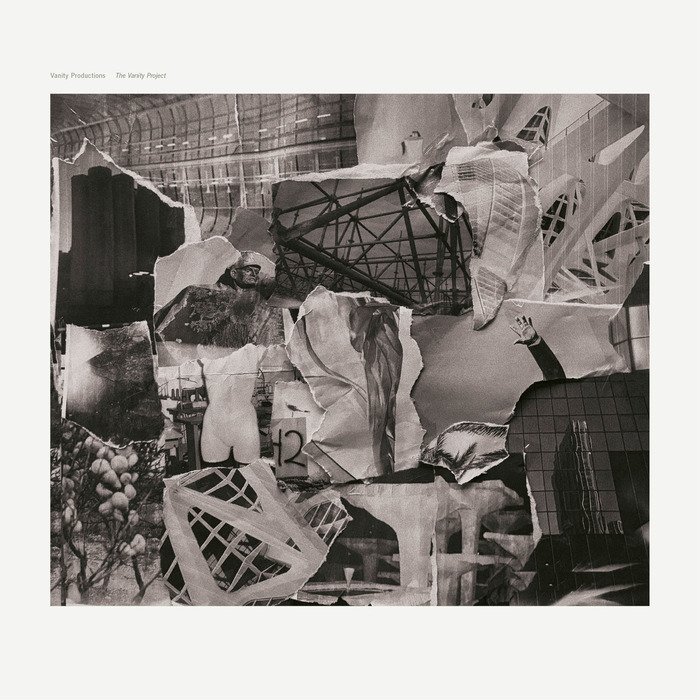
Vanity Productions, “The Vanity Project” (Northern Electronics, 2026)
This long-running solo project from Posh Isolation co-founder Christian Stadsgaard has gradually evolved from its modest minimal techno beginnings into a vision that inventively blurs the lines between harsh noise, ambient, and contemporary classical. While he has certainly kept one foot firmly rooted in the noise scene with collaborative releases with Merzbow, Evil Moisture, and Government Alpha, the overall arc of the project has mostly been towards striking the perfect balance between beauty and violence. His most notable success in that regard before now was probably the static-gnawed ambiance of 2024’s The Night Has Passed Already, but The Vanity Project feels like another big creative breakthrough, as the more beautiful elements have a more timeless/sacred feel this time around that puts some significant distance between Stadsgaard and his peers in the contemporary ambient milieu. Also, both Merzbow and Government Alpha turn up to help ensure that Vanity Productions’ sharper edges remain every bit as visceral and snarling as ever.
The opening “Hoarfrost” provides an especially haunting and sublime introduction to the album, as a brief haze of whines and brittle piano fragments unexpectedly blossoms into lush organ drones that subtly warble and shimmer in pleasantly trippy ways. It gets even better from there, however, as a looping two-note “dial tone” melody fades in to provide a haunting, unconventional, and short-lived melodic hook before the piece evolves into a killer final stretch that sounds like a warmly beautiful organ mass with a seething and enigmatic undercurrent of tape loop noise squall.
It’d probably still be an achingly beautiful piece even without the noise-ravaged final act, but those noisier bits are actually the conceptual heart of the album, as Stadsgaard uses the “residual noise of contemporary media space” as his source material and “collapses source and signal” by processing “social media remnants, dark web transmissions, and untreated human sound” through “noise electronics and tape manipulation.” Unsurprisingly, those fragments are largely obliterated into unrecognizability, yet Stadsgaard uses them in an incredibly effective way, as most of these eight pieces artfully transform a simple organ, harmonium, or string motif into increasingly unstable and harrowing terrain as the volatile undercurrent of noise starts to boil over.
While the whole album is essentially one great variation on that theme after another, the album’s first half in particular features an unbroken run of four stunners in a row. In “This Could Be Forever,” for example, another haze of whines converges into a lush drone motif with an accompanying swell of gnarled, howling noise that impressively resembles wild animals armed with chainsaws. Elsewhere, the murky, swirling, and dreamlike orchestral fantasia of “Anamorphic Widescreen” gradually develops a dissonant and curdled edge as splattering and sputtering noise squalls billow up from the depths.
“Assemblage” takes a bit longer to come together, as it initially evokes the haunted ambiance of lysergic birds fluttering around the ruins of a bell tower, but its bleary and wistful chords float over an increasingly volcanic and spacy sea of panning bloops and feral noise intensity from Government Alpha’s Yasutoshi Yoshida. Unsurprisingly, the closing title piece with Masami Akita is a wonderfully slow-building and visceral eruption as well, as a smoldering noise squall quietly gathers strength beneath a melancholy string motif until the veil is pulled away for a howlingly intense and cathartic finale with an abrupt end.
Listen here.