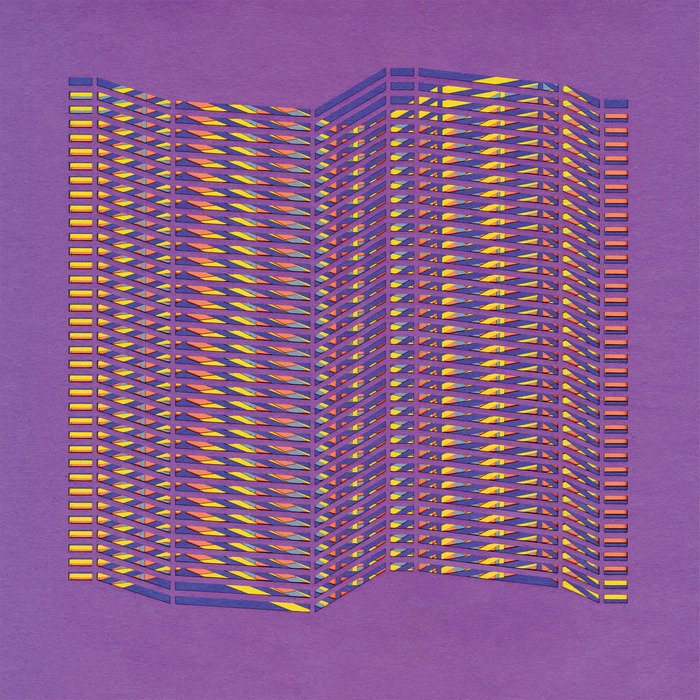
I was quite a big fan of this Swiss pianist’s solo debut (2022’s Keemuun), which is rather fortuitous because this latest album is both the spiritual and literal descendent of Keemuun’s swirling and delirious prepared piano workouts. More specifically, Figuren’s source material comes from ten intimate studio performances of pieces from Keemuun that have now been unrecognizably transformed through “deconstructed melodic elements, isolated individual tones, and extracted resonances.” While some reworkings from that process apparently surfaced on Loher’s previous album (the more dissolved and hazy Hug of Gravity), they have since undergone yet another radical transformation, as Loher ran fragments of melody through a Revox B77 tape machine and “subtly altered their pitch before digitizing and reshaping them once again.” The result feels akin to a cool tape loop album, as repetition and distressed tape effects transform Loher’s melodies into a beautifully broken, haunted, intimate, and otherworldly soundworld of lingering dissonances.
I was recently struck by how Loher’s solo piano work loosely parallels William Basinski’s career, as Basinski has spent years weaving magic from a box of old tapes while Loher has now released three albums distilled from solo recordings made while his main project (KALI Trio) was on hiatus during the COVID pandemic. The similarities do not end there, however, as Figuren also captures Loher at his most minimal, as these eight pieces are all composed of simple melodic fragments that resemble two or more tape loops that are sufficiently out of phase with one another that gradual and subtle transformations occur. Unlike Loher’s considerably more intense main project, however, these piano miniatures are never headed towards any sort of explosive crescendo or big payoff and instead seem to linger in a state of hypnotic suspended animation (a situation that I am perfectly ok with). In fact, Morton Feldman is probably the closest reference point, as Loher excels at transforming seemingly disjointed and pointillist clusters of notes into sublime reveries of uneasy dissonances and lingering decays.
In my favorite piece, “Figuren I,” a few murky and melancholy chords bridged by a delicate melody languorously loop with minimal variation. While it is admittedly quite a brief and overtly simple piece, those notes leave behind a tenderly beautiful ghost trail of quavering decay and subtly shifting harmonies and that ghost trail is the real show as far as I am concerned. The following “Figuren II” is another sublime highlight, as a stammering and pointillist prepared piano motif seemingly overlaps upon itself to subtly transform the rhythm, harmony, and melody. Elsewhere, “Figuren VI” weaves dark magic from the collision of a disjointed harmonic-like melody and the insistent pulse of a murky bass note, as it feels like two patterns are getting closer and closer together in a cramped space to conjure a sense of increasing tension and volatility.
The closing “Figuren VIII” is yet another quiet stunner, as it feels like a cut-and-pasted and off-kilter progression of darkly jazzy chords fitfully disrupted by small hesitations. It calls to mind a malfunctioning and lovesick player piano mechanically expressing its heartache with a stumbling and obsessive motif that loops into eternity. Unsurprisingly, the remaining pieces are similarly understated variations on circular, faltering, and broken minimalist melodies and they are all quietly mesmerizing as well. While I suspect that this album is probably the logical endpoint for Loher’s inventive deconstruction and mutation of Keemuun’s source material, it is entirely possible that he will someday surprise me again and pull yet another rabbit out of his hat. If not, he definitely managed to end this series on a high note, as the whirlwind intensity of Keemuun and the tender, haunted miniatures of Figuren are as different as night and day, yet both are boldly original, sophisticated, and fascinating works of art.