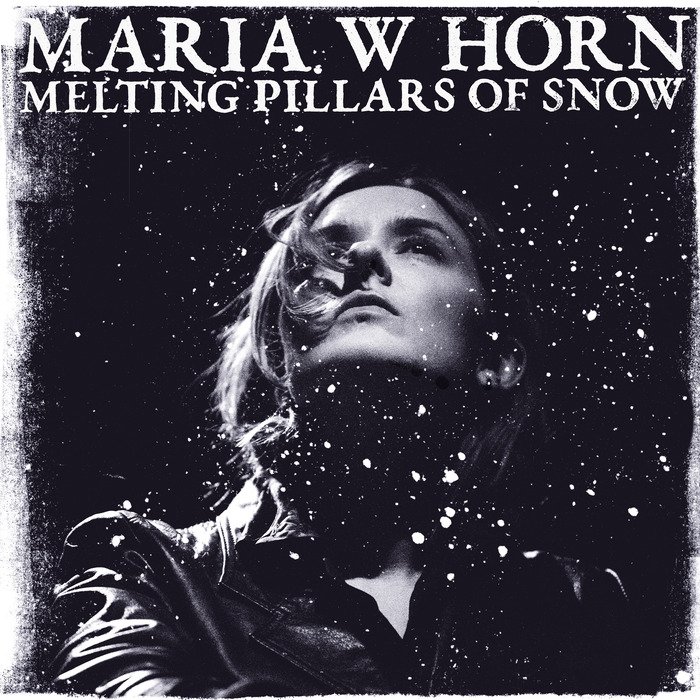
Maria W. Horn, “Melting Pillars of Snow” (XKatedral, 2026)
This latest opus from Swedish composer and XKatedral co-founder Maria W. Horn is billed as her most ambitious work to date, as she enlisted a full chamber ensemble for a mind-melting five-song suite inspired by W.G. Sebald’s The Rings of Saturn. Aside from the scope of the instrumentation and its literary roots, Melting Pillars of Snow is also notable for its unusual instrumentation (Shō, dobachi, overtone triangle, pitched wine glasses, etc. ) and Horn’s own “customized algorithmic synthesis” and distinctive processing techniques. It is also notable for being quite a darkly mesmerizing mindfuck, as Horn warps and pitch-shifts her own voice for some truly unsettling and otherworldly spoken word passages. Unsurprisingly, all of that makes for quite an intense and challenging plunge down the rabbit hole, as it feels like several disparate realities are bleeding into one another to rather sanity-dissolving effect. That is not at all what I would have imagined from a Sebald-inspired work, but it is certainly one hell of a memorably wild ride.
Horn does not waste any time in plunging directly into the void, as the darkly lysergic opener “Scythe of Saturn” is centered upon a heavy drone motif that feels like it is dissolving into rotating fractals before celebrity guest monologist Michael Gira turns up to deliver portentous lines like “an endless graveyard for humanity struck by falling sickness.” That is undeniably quite a killer way to open an album, as it feels a bit like David Lynch blurred together with rustic folk horror, but the piece then abruptly transforms into a long stretch of breathy woodwind drones that feels a bit like a sad, slow, and slowly deflating calliope melody. The following “Melting Pillars of Snow” is somehow even more disturbing and unsettling, as it is a gnarled nightmare of Horn’s whispered and unnervingly warped narration (“there is no antidote against the opium of time”) disrupted by jarring percussion splashes that leave behind a wobbly and lingering decay. There are also some more woodwind drones and possibly the sounds of a passing tractor and I have absolutely no idea what it all means, but it does not matter because it feels like time and space have begun viscerally rippling and distorting within Horn’s deeply immersive spell of cosmic horror.
As if the dissolving fabric of reality was not enough, it then starts to rain as well in the following “The Grand Oak/Tidens Tro,” but things are otherwise a bit less disturbing, as an expanding and shimmering haze of glassy tones with occasionally distorted edges gradually forms over a progression of breathy pipe organ-esque chords. It evokes something akin to a billowing and gradually expanding supernatural glow of shifting colors, but at least it isn’t a malevolent one. Unsurprisingly, that absent darkness soon comes back with a vengeance in “Owershadowed by Mortality,” as Horn’s witchy, pitch-shifting voice returns to tell me that the stars are now coming out from the depths of space, but the piece eventually overstays its welcome with a long stretch of more pipe organ-esque drones, which unavoidably feels anticlimactic after the black metal-esque intensity of Horn’s narration. Happily, however, she saved the best for last, as the closing “A handful of Dust” is a wonderfully hallucinatory miasma of overlapping pitch-shifted voices all reading the same unsettling poem before it unexpectedly blossoms into a warmly buzzing and harmonically rich drone piece that is gradually reduced to just wood, steel, and chant-like vocals.
While I remain a devoted longtime fan of Horn’s work, I found this one to be an extremely challenging album to wrap my head around for a whole host of reasons. The main one is that these pieces have an elusive compositional logic in which I was often wrong-footed by the transitions between various themes, as the ground seemed to be continually shifting beneath me in alien and dreamlike ways. Also, damn near every single one of my expectations for a new Maria W. Horn album was subverted in one way or another, as voices unpredictably warp, stretch, and shift in pitch and ancient and/or Japanese instrumentation bleeds together with field recordings, farm machinery, and more black metal-inspired atmospheres. Perhaps I need to read The Rings of Saturn again to get myself on Horn’s blackened, temporally disorienting, and deeply psychogeographical wavelength, but I do not need to fully understand her inspirations and motives to grasp that this album is fascinating maelstrom of light, dark, past, present, and future that feels like a scrambled transmission from a coven of witches living in a post-apocalyptic and post-technological future. In any case, I feel slightly insane now. Horn was definitely swinging for the fences with this one.
Listen here.